Posted

by Alissa Brooks

Hello world! My name is Alissa Brooks. I am a recent graduate of Walsh University in North Canton, Ohio and I travelled a couple thousand miles to attend this workshop. In between classes and interviews, I am also updating the social media sites and blogging. Here is my first post!

“…all of us who do creative work we get into it because we have good taste.  But there is this gap.  For the first couple of years you try to make stuff, and it’s just not that good. It’s trying to be good, it has potential…The most important thing you can do is do a lot of work…It is only by going through a volume of work that you will close that gap, and your work will be as good as your ambitions.”        – Ira Glass, NPR

Day three of the STF workshop is just beginning, and as the group settles in to their seats some are saying, “I can’t wait to get on location and film” and “I think we really have a story here.” They are referring to the two heroes selected to share their personal stories and how they discovered Foundation for Women (FFW), micro-credit loans, and the impact each are making on their lives.

Photographer Toni Cervantes during a phone interview with women hero.

Yet, who are these people that are going to be behind the lens?  The short answer is they are six diverse individuals, each offering a skill set that forms a team of experts need to produce documentary media for a non-profit organization.  Further, they are students, of all ages and backgrounds, that want to learn how to hone their craft and learn new skills.  Even deeper, they are activists, parents, artists – all united in San Diego to learn and create.

The first part of documentary filmmaking, as the group learned yesterday, is research.  Part of research involves casting.  Six FFW loan applicants and recipients shared their stories.  The critical part was to pick whose story represented best the organization, the mission of the “I Challenge Life Campaign,” and resinated with our group.

Toni Cervantes, a workshop participant, was critical in casting.  Currently, she’s a photographer who documents cornea transplants throughout the world.  Before she began this project she was a commercial and music video casting director based in Los Angeles.

“For me this whole class is exemplary of that everybody has a story to tell.  If you ask the right questions, you find the story.  People always surprise you.  The quietest person can have the most profound wisdom to depart.  The most bubbly person can be on antidepressants.  You just don’t know.  My thing is – never underestimate anybody and what they have to say.”

Casting is just the first step.  There will be storyboarding, photographing, interviewing, transcribing, and editing.  Along the way information, advice, stories, and memories will be gathered – each a experience to add to their individual volumes of work.


Posted

Hello from sunny San Diego! The STF team is here leading a workshop for six talented photographers, storytellers, interviewers, and filmmakers to produce media for Foundation for Women’s (FFW) “I Challenge Life!” campaign.

Over the past couple of months, STF and FFW have worked together to determine how we, as media producers, can help raise awareness about their work in the U.S. to empower women through microcredit loans. After many emails, phone calls and time researching FFW’s online presence, we decided that in-depth personal stories of the loan recipients, who we’re calling “heroes”, would help the organization the most to achieve their campaign goals.

Which brings us here to San Diego, where we will start media production on Monday. Until then, we’ll be in the classroom learning how to capture the stories of these powerful women that are truly challenging life.

Stay tuned throughout the week for more updates on the workshop, campaign and production! You can also follow us on Facebook, Twitter and the hashtag #stfwksp.

Posted

Social media is changing the way people engage, communicate, bond, connect and network with each other on a global scale. Much like other pivotal shifts in history, such as the Industrial Revolution, there is no turning back from these profound technological developments.  However, not everyone has the knowledge to use these communication tools effectively, namely non-profits and non-governmental organizations (NGOs) primarily in developing countries.

The plight of the non-profit has never been easy – the majority have always been faced with unstable funding sources which dictate how many services they can offer and to whom.  As social media evolves and becomes more accessible to the masses, the competition between NGO’s also increases as they struggle to keep up with the fast-paced, ever-changing media landscape in order to gain and maintain secure funding.

The problem is that so many innovative programs are being run by NGO’s that don’t have the resources to tell their story effectively or reach the audiences they need to in order to receive recognition, support and funding.

I’ve spent the last eight years creating media for organizations that work to advance women and girls.  I’ve worked for larger organizations like UN Women and CARE and some smaller like OneHeart, and for the most part they all needed help defining their story; from refining their message to finding the most effective avenues to distribute their media.  For these reasons I am leading Social Documentary Workshops as part of a current project of mine, Stirring the Fire.  These workshops are intended to help advance gender equality by enabling women’s organizations to tell their story effectively and give them online strategies to get that story in front of their target audiences.

Our upcoming workshop in San Diego is sold out, but if you are a journalist, photographer, filmmaker, graphic designer, social media/communications student or professional, you can fill our this application to apply and be added to our mailing list for upcoming workshops (hint: the next destination might be near or around Nepal).

Our vision is to see this model not only scale but evolve, giving media students and professionals who would like to do social documentary work real world experience, and at the same time providing selected NGO’s with an affordable solution to effectively tell and get their story heard.

Posted

I have a 30 day documentary film project in Dolpa, a remote part of Nepal, which I’m going to be away from power for almost 30 days.  This is the first time since I converted to digital capture that I’ll be off the grid for so long.  I emailed some colleagues who shoot for NorthFace and had been given some pre-packaged products (by Goal Zero and Brunton) that they claimed did not work for their needs.

In researching the subject here is what I’ve learned:

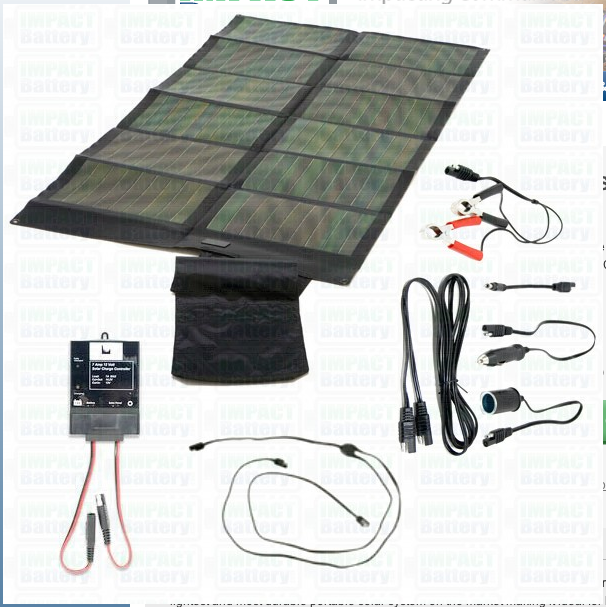
1. To power my 15” Macbook pro, camera batteries (Canon Mark II & III 5D’s] and  various AA’s I need a 60 watt solar panel.  The lightest and most compact I have found is the P3-62 Foldable Sunling panel.  It weighs 3 lbs and folds up to 15”x 8” x 1.5”

62 W Sunling panel kit  $849  http://www.impactbattery.com/p3-62w-black-solar-panel-kit.html

2. From the panel I will be charging a 12 VOLT 10 Amp Hour  LITHIUM IRON PHOSPHATE BATTERY (LFP).   LFP batteries are half the weight of lead acid batteries and are cheaper and more environmentally friendly than Lithium cobalt batteries.  This one weighs 2.5 lbs. and is 6” x 2.5” x  3.8”.

10 Amp Hour LFP battery  $150  http://www.wholesalebatteriesdirect.com/66438-12-volt-10-ah-lifepo4-lfp12v10-lithium-iron-phosphate-battery.html

*note–It is necessary to have a controller between the solar panel and the LFP battery to avoid over-charging.  The Sunling Panel kit listed above comes with a controller.

3. I plan to have the solar panel charging the battery outside my tent during the day then charging my various devices off the LFP battery at night.  Here are some adaptors needed to charge my various devices from the LFP battery:

Battery to cigarette socket connector  $5

http://www.amazon.com/gp/product/B00065L2D8/ref=pd_lpo_k2_dp_sr_3?pf_rd_p=486539851&pf_rd_s=lpo-top-stripe-1&pf_rd_t=201&pf_rd_i=B0018NB3OK&pf_rd_m=ATVPDKIKX0DER&pf_rd_r=14YYH1GE3F4RSPD4TWG0

3 way Cigarette Socket splitter  and USB port  $3

http://www.amazon.com/Three-Way-Cigarette-Lighter-Socket-Splitter/dp/B0018NB3OK/ref=pd_cp_e_1

Canon 5D adaptor $20 http://www.bhphotovideo.com/c/search?Ntt=peadccnlpe6&N=0&InitialSearch=yes

Macbook adaptor $28

http://www.amazon.com/Charger-Macbook-Mb283ll-Mb940ll-Notebook/dp/B004SBYHNI/ref=sr_1_1?ie=UTF8&qid=1331446268&sr=8-1

Total cost–$1055

Canon 5D adaptor $20

Posted

Multimedia storytelling empowers individuals and organizations; When used correctly it can inspire entire movements, bring communities together, raise awareness about social justice issues and give nonprofits a vital tool to amplify their message.

It’s for these very reasons and due to the overwhelming response for our social documentary internships that Stirring the Fire would like to announce our new multimedia workshops.  STF workshops will serve to help nonprofits that work to promote gender equality, to tell their story and give them online strategies to get that story in front of the audience they need to reach.

The workshops will differ from the internships in that there will be formal production and post production training.  Our founder Phil Borges explains briefly, “more and more nonprofits need multimedia, so I’ve decided to do these multimedia workshops to provide formal training in storytelling, film, photography, audio, editing, post production, and distribution.”

Our next workshop will be July 13-22nd in San Diego working with Foundation for Women, an organization that changes lives through microcredit finance, and by encouraging entrepreneurship as the solution to eliminating poverty.  We will be documenting their US microcredit programs, but focusing on their San Diego loan groups.  Apply here!

Posted

Reel Grrls by Sunni Campbell

During the summer of 2011 I had the privilege of interning for a non-profit organization named Reel Grrls, dedicated to empowering young women from diverse communities through media literacy.  Each year over 80 young women participate from several programs offered through out the school year and during the summer.  Reel Grrls is a unique media and technology training organization that empowers young girls to not just critique the media images that surround them, but to learn important technological skills in order to create their own media.

Circle up mainspace

Doc Arts Camp 2010

Residing in the Central District of Seattle, Reel Grrls fosters the importance of educating young women and cultivating important leadership skills vital to their future.  Reel Grrls offers a variety of hands-on workshops for adolescent and teenage girls in technology skills such as animation, cinematography, script writing, video blogging, apprenticeship programs, and other teen video camps.

These workshops take place during the school year as after school programs, and during spring, summer, and winter breaks.  The workshops also vary in skill levels, some are directed at younger youth ages from 9-13, while other programs are more advanced and target youth 13-18.  The tuition varies based on the length of each program and technology being used, but Reel Grrls does offer scholarships for youth that simply can’t afford to pay full tuition for programs!

framing 9
Teen Video Camp June 2011

There is a small dedicated full-time staff of five women including the executive director who keep Reel Grrls going, as well as several rotating Mentors and instructors who come in to help with different aspects of each workshop.  I was one of two interns at the time, and I mainly worked with the technical media and program managers.  There are so many different ways to get involved with Reel Grrls, and they are always looking for new talent, fresh minds, and strong, creative, independent young women who can be mentors, volunteers, and interns to help inspire and teach young women and girls.

If you’re interested in being an intern, I can tell you from my experience that this is an amazing organization to be a part of, and the experiences and skills you will pick up are invaluable.  I was not only inspired through my internship time spent at Reel Grrls, but I took away a passion to continue my education with digital media, film, and technology, and have learned both from the staff and the students.  Internships at Reel Grrls vary, but they are always seeking technical, program, and marketing interns. Volunteer positions are similar to those of interns, and vary depending on skill sets, and the capacity in which you would like to help out at Reel Grrls!

Animation in classroom 2

Animation Camp 2011

Becoming a mentor for Reel Grrls is another great way to get involved, and their main requirement: “is a commitment to empowering young women through media production. In exchange for their hard work, mentors gain access to Reel Grrls video equipment and the opportunity to network with other Seattle-based filmmakers, artists, activists, and educators.”  Technical mentors are experienced filmmakers familiar with either camera, audio, lighting, or editing.  Youth Development mentors  “help to create an open and safe environment for girls in the program by leading group-building activities, being active listeners, and providing girls with emotional support during the program.”  There are also curriculum mentors, and workshop leader positions; check their website for more info, or you can apply online.

Other ways to get involved are are becoming a Reel Grrl yourself if you are age 12-19, its fun and you will not only learn about the technology to create your own media, but you will learn about teamwork, leadership, and responsibility. For those who need extra financial aid for programs at Reel Grrls, they offer schoalrship as I mentioned earlier. This however would not be possible without donations, and scholarship contributions.  If you don’t have the time to volunteer or intern, you can donate to a great organization to support the grrls fund, and give a young girl the gift of media!

In the current climate where digital media is so prevalent, organizations such as Reel Grrls play an important role in social learning education.  The value of media literacy is growing as the technology for self expression grows, and the work that Reel Grrls does in educating young women in digital media is key to the technological competency of the youth.

For more information:

Reel Grrls Website

or you can Follow them on Twitter and Facebook

info@reelgrrls.org


Posted

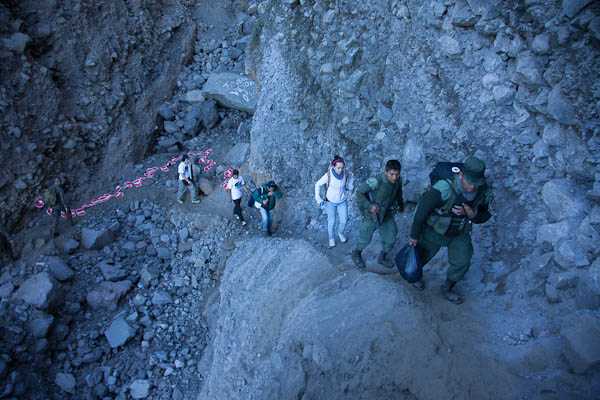
I managed to finagle my way onto the walk up the Volcano de Agua.  We set out at 4:00am to catch the buses from Antigua to the town of Santa Maria  where the hike began – at 5:30 we started the hike up the volcano.

One of the narrower parts of the trail

The altitude, terrain and number of participants made for a hike that was fairly strenuous.  As I was walking I found it interesting and encouraging that the majority of the participants were men since this was an event to bring about awareness to and reduce domestic violence.

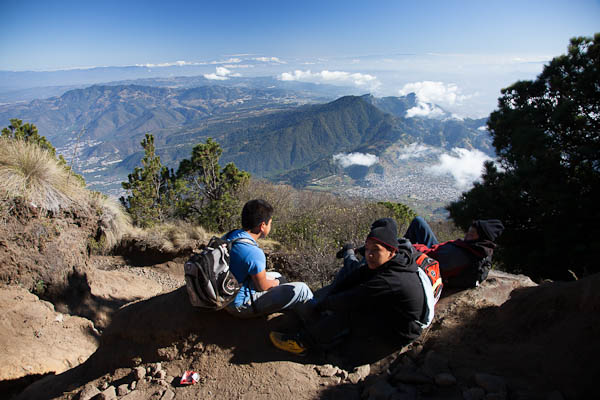
Above the clouds

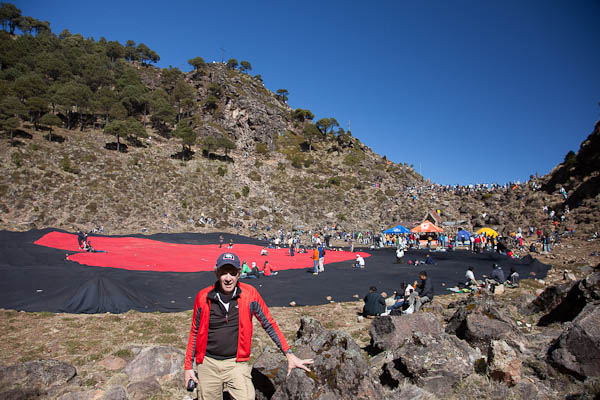
After about 4 hours I made it to the top where people were waiting for the announcement to create the human chain.  There were plenty of reporters and helicopters with film crews to document the event.  Spread out across the crater was a gigantic piece of nylon with a huge heart printed in the middle of it.  Everyone gathered around, picked up the canvas and began to wave it up and down.

Preparations to form the heart in the center of the crater.

At the heart of the crater

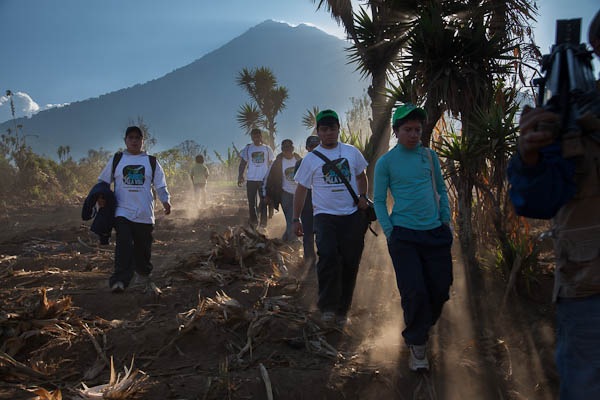
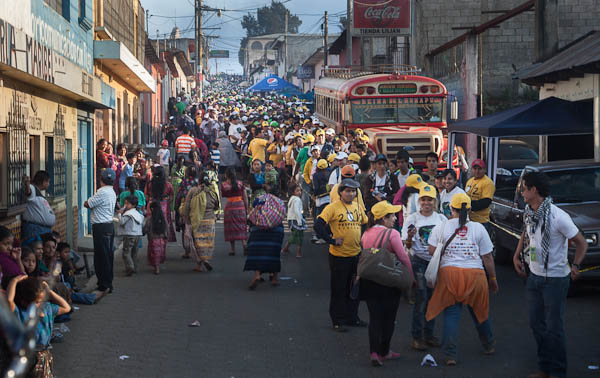
Further down the volcano thousands of people lined up to pass a flag up the mountain to the crater.  The trip down with thousands of people trying to negotiate a mostly one lane path, in addition to the dust they created made for a very long and uncomfortable descent.  Once we were back in Santa Maria the number of people that took part in this event overwhelmed the busses that were designated to take them back to Antigua.  I understand that some people waited about 3 hours for a bus.

The dusty trail

The masses waiting for a bus to return to Antigua

On a whole I commend the organizers – while there were many things that could have been done much better, the idea and the amount of work and organization to pull off something like this was still impressive. This event was organized by Ensena Amor: No Violencia (Teaches Love)

Posted

Editor’s Note: Stirring the Fire comes to you from Guatemala where our team is producing a documentary about how Population Council Guatemala is preventing violence against Mayan women.  STF team member Kara Marnell reports from the field below.

As I knelt down and searched the bright brown eyes of a little Mayan girl, I saw a future far different than what her eyes might see today.  I predict a future, filled with hope and opportunity, a girl who would know confidence and self-determination.

Young Mayan Girl

The town of Maya Kaqchikel is an indigenous community on the outskirts of the bustling city of Sololá.  Though it is a mere 20 minutes from Sololá, Maya Kaqchikel is free of tourists and shops.  Instead, its dirt roads wind between the ribbons of corn and working women with babies sashed to their backs decorate the landscape.

Maya Kaqchikel

The Stirring the Fire team had the pleasure of visiting this remote community on Saturday and meeting its warm and welcoming people.  The men and women stood side-by-side smiling as their young, excited children ran to greet us, some barefoot, others with clean but threadbare clothing.

In 2010, the community of Maya Kaqchikel became Population Council’s pilot community for its ‘Safescaping’ initiative, an effort to engage young female leaders to actively help determine what constitutes a “safe community” in answer to gender based violence and to help identify local paradigms that constitute various threats to girls’ safety.

Girls Who Participate in Safescaping Programing

As in many communities, the men here didn’t view themselves as the perpetrators of violence.  We’ve noticed time and time again that violence is so normal in these communities that it seems simply the way of life, the culture.  The community was reluctant to make changes fearing the admission that violence was a real problem.  Like so many issues, admitting there is a problem is the first step toward fixing it.  Ángel del Valle, the Monitoring and Evaluation Coordinator for Abriendo Oportunidades, explained how the community underwent 40+ hours of training and development to expose the common, everyday violence that women endure.  During the training, a powerful activity helped bring these issues to light and sparked an incredible change in the community.  First, the men and women were divided into two separate groups and given a tree.  Then, each group was asked to identify the “roots of violence.”  After completing their trees, the men and women came together and shared their differing perspectives.  The men saw violence (the little they perceived), as stemming from financial burdens and alcohol abuse.  The women, on the other hand, stood up for the first time, and declared that the females of the community worked twice as hard as the men and simply were not appreciated.  In response, a community leader, a man, rose and admitted that he had never realized that the women worked so hard.  Each day he returned home expecting dinner after a long day’s labor in the fields.  Yet, never before had he realized that the women were also working all day in and around the house, tending to the children and, even though they too were tired after a long day, they continued working to serve their husbands.
It was a breakthrough.

So simple, but so real.

All of this occurred a year ago.  Already, there has been a transformation and the community was proud to share their progress born of this understanding with our team. So, on this day, the community had prepared a series of reenactments to illustrate the violence that commonly occurred in the household and how the community had learned to tackle these tough issues.  How incredibly generous of this community to allow foreigners to see such a raw, open and rare view of itself.

Community Leaders in Traditional Dress for Reenactment

Violence against women is still a continuous battle here. Ángel thinks that domestic abuse still continues but an evolution, a revolution is beginning.  It’s not enough, he says, to simply create ‘noise among the girls’, but community focus and mobilization must occur for enduring change to take place.  This has been a community problem.   It takes a village to change the culture.

As we pulled away in the van, the men and women stood side-by-side thanking us earnestly for our visit.  It was then I realized that the men and women standing together was a symbol of their newfound sense of equality.  I waved goodbye to the little girl with bright brown eyes and thought that she now has a support group that many before her did not, the seed for a promising future.  A future taken for granted now in so many places far from here.  There’s hope for her.

Indigenous young women as change agents against violence in Guatemala

The high prevalence of gender-based violence in Guatemala leaves Mayan women and girls living in poor and isolated communities particularly exposed to risk. In a powerful approach to empower indigenous young women as agents of change in their communities, Population Council Guatemala, with support from the UN Trust Fund to End Violence against Women, is pairing them with mentors from local organizations, to engage them in a range of prevention activities.

Among other things, the girls undertake GPS-based community mapping, plotting every household, building and route to produce maps that show where girls and women feel safe or at risk. The maps are making young women and their safety concerns visible for the first time, catalyzing community-wide discussion about violence against women and girls and ways the community could come together to prevent it. In addition, Population Council is training a cadre of girl leaders in participatory video to highlight issues of gender and violence in their communities.

The UN Trust Fund to End Violence against Women, administered by UN Women, is a leading source of support for efforts to end violence against women and girls across the world. You can join this vital work by donating to the UN Trust Fund and by taking action at Say No – UNiTE to End Violence against Women.

Posted

Editor’s Note: Stirring the Fire comes to you from Guatemala where our team is producing a documentary about how Population Council Guatemala is preventing violence against Mayan women.  STF team member Kara Marnell reports from the field below.

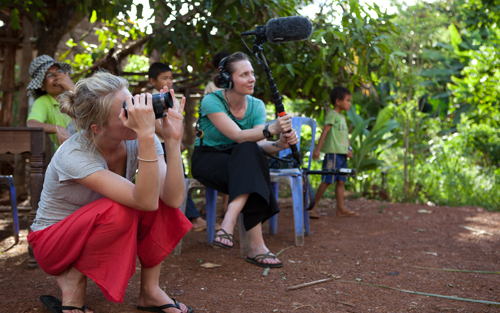
During a powerful and eye-opening week of travel, interviews and filming in Guatemala, we have had the privilege to get to know several female leaders in various communities who are working hard to educate and change the lives of other females.  One group, in particular, is doing so creatively through the use of film.  This group, comprised of twelve girls between the ages of 15-23, has been learning about filming, editing, and using visual techniques to create and screen films that engage communities and urge discourse on the issues that affect females.  This ‘participatory film program’ is run by Insight Share, an organization with stations all over the globe.  Insight Share also collaborates with other groups, such as Abriendo Oportunidades, using this participatory video as a tool to teach young adults new skills in order to build self-confidence and educate women on the ways to stand up for themselves and to open doors of opportunity that might never have considered.

Soledad Muñiz, the associate country coordinator for Insight Share, explained how she has witnessed an incredible, gratifying transformation in these young women.  At one time hesitant to gather testimony on film, the girls now bravely take on the city, approaching strangers, seeking their opinions on various issues as if they are seasoned reporters.  Opportunities for woman are so woefully lacking in Guatemala that the participants view this program as a unique and exciting way to develop new skills and insights beyond any of their peers.   The girls also find power in their team.  They spend a month in training together, away from their families.  In fact, for some, it is the first time ever away from their families and that leads to ‘group trust’ and builds individual confidence, says Muniz.  These girls truly embrace all the program has to offer while still continuing their regular schooling, family responsibilities and their positions as girl leaders in their communities.

Hermelinda Teleguario, a 21 year old Guatemalan woman, faced our cameras to discuss the pressures that face teenage girls in her country, especially family pressures to marry at a young age, indeed, as early as 14 years old.   While Hermelinda is grateful to have a boyfriend that respects her and a family that allows her the freedom to marry whom and when she pleases, many other Guatemalan girls are not so lucky.   Some girls, even some of Hermelinda’s friends, find themselves married very young.  They soon have children and responsibilities they are not prepared to manage, neither emotionally mature or financially secure to assume.  By then it’s too late.   Still other girls see marriage as the only option to escape family situations and there is no escape at all.

Up Next: Alejandra Maria Colom is the program coordinator for the Population Council’s Guatemala office, overseeing “Abriendo Oportunidades” and maternal health projects.

Stirring the Fire has the opportunity to meet with Ms. Colom on Monday to discuss the issues that Guatemalan women face as well as the steps taken to combat the brutality endured by Guatemalan women and girls.

As we prepare for our interview with Ms. Colom, we would like to reach out to our followers. Do you have any questions you would like Stirring the Fire to ask about the social issues here in Guatemala?

Indigenous young women as change agents against violence in Guatemala

The high prevalence of gender-based violence in Guatemala leaves Mayan women and girls living in poor and isolated communities particularly exposed to risk. In a powerful approach to empower indigenous young women as agents of change in their communities, Population Council Guatemala, with support from the UN Trust Fund to End Violence against Women, is pairing them with mentors from local organizations, to engage them in a range of prevention activities.

Among other things, the girls undertake GPS-based community mapping, plotting every household, building and route to produce maps that show where girls and women feel safe or at risk. The maps are making young women and their safety concerns visible for the first time, catalyzing community-wide discussion about violence against women and girls and ways the community could come together to prevent it. In addition, Population Council is training a cadre of girl leaders in participatory video to highlight issues of gender and violence in their communities.

The UN Trust Fund to End Violence against Women, administered by UN Women, is a leading source of support for efforts to end violence against women and girls across the world. You can join this vital work by donating to the UN Trust Fund and by taking action at Say No – UNiTE to End Violence against Women.

Posted

Editor’s Note: Stirring the Fire comes to you from Guatemala where our team is producing a documentary about how Population Council Guatemala is preventing violence against Mayan women.  STF team member Kara Marnell reports from the field below.

Maria is full of grace.

At 24 years old, she might have been ‘ordinary’ except for the lifetime of suffering she has already endured and overcome at her young age.

Maria Chicoj’s mother died when she was the tender age of 12, leaving Maria, seven sons, another daughter, and a husband who struggled to support his family and turned to alcohol for comfort. The alcohol fueled domestic violence and Maria was his regular victim.  But she was never defeated.

Today, Maria is an advocate for women and adolescents as a Social Change Agent with DEMI (The Defense of Indigenous Women) in Quetzaltenango.  Self-assured and not much taller than most of her students, Maria scans her classroom, making eye contact with each one of her young female students as she discusses the stages of womanhood.   She wasn’t always this confident.  After her mother passed away, Maria dropped out of school and became the substitute mother for her seven brothers and younger sister, a nearly impossible job for a young girl but nonetheless an expected role.  After more than a decade of brutal beatings by her father, she made a decision to finally stand up for herself and create a different life, one of strength and dignity.

Hearing that DEMI was interviewing for an internship program, Maria found an excuse to leave the house and attend the interview.  She did so with considerable risk.  In fact, DEMI is an organization that is not supported by the Guatemala government and is otherwise not very welcome.  In fact, it’s routinely protested by men in Guatemala.  A day later after the interview, Maria was awarded the internship position.  It was the first time in her memory that she felt valued.

That was only a year ago.

What a difference a year makes in the life of one person determined to make changes.

Maria’s story is not an isolated one.  In Guatemala, women are among the most marginalized.  This human rights crisis is surging in Guatemala, a nation with a grim history of violence and decades of civil war, as abuse against women has reached a record high.  According to the UN, nearly 45% of Guatemalan women have suffered some form of violence in their lifetime and cases of rape and even murder is widespread.  While a corrupt patriarchal society rooted in inequality may have tolerated such injustice, global initiatives are dedicated to combating the brutality faced by these women and young girls.

The challenge to replace stories of abuse and oppression, such as Maria’s with respect and safety and confidence is daunting. But, positive change is possible one person, one household at a time through efforts to raise awareness about the issues women face and, in doing so, inspire others to join in the global movement to end gender inequality.

With a smile in her eyes, Maria moves through her community with credibility as a veteran of domestic abuse with a determination and a powerful message for girls.  Like a warrior, Maria is trying to move mountains.  In addition to her internship with DEMI, empowering young girls, Maria still cares for her family, her father, and also continues with her schooling with the hope of becoming a lawyer and perhaps a more formal, legal voice for Guatemalan women.  She reveals no signs of fear, defeat or even fatigue but, instead, exhibits passion and energy to make a difference in the lives of young women in her community, her country.

Today, Maria smiles broadly even around the father who beat her repeatedly.  And, sober now, he accepts his daughter’s role with some pride as he listens to her message and visits the shelter where she fled to escape his demons.  He is a regular subject in her narrative as the thief who helped steal her childhood.

Maria forgives but cannot forget, should not forget.  She cannot let others forget an all too common story confronting woman and girls in Guatemala.

Her experience is part of who she is and what she stand for today.  To offer it to others is a gift.

Indigenous young women as change agents against violence in Guatemala

The high prevalence of gender-based violence in Guatemala leaves Mayan women and girls living in poor and isolated communities particularly exposed to risk. In a powerful approach to empower indigenous young women as agents of change in their communities, Population Council Guatemala, with support from the UN Trust Fund to End Violence against Women, is pairing them with mentors from local organizations, to engage them in a range of prevention activities.

Among other things, the girls undertake GPS-based community mapping, plotting every household, building and route to produce maps that show where girls and women feel safe or at risk. The maps are making young women and their safety concerns visible for the first time, catalyzing community-wide discussion about violence against women and girls and ways the community could come together to prevent it. In addition, Population Council is training a cadre of girl leaders in participatory video to highlight issues of gender and violence in their communities.

The UN Trust Fund to End Violence against Women, administered by UN Women, is a leading source of support for efforts to end violence against women and girls across the world. You can join this vital work by donating to the UN Trust Fund and by taking action at Say No – UNiTE to End Violence against Women.