Posted

Editor’s Note: Stirring the Fire comes to you from Guatemala where our team is producing a documentary about how Population Council Guatemala is preventing violence against Mayan women.  STF team member Kara Marnell reports from the field below.

Irma Catú is a Population Council Guatemala Social Change Agent

Capaz—Spanish for capable.  This word was repeated numerous times while we met with several young, dynamic women who work at Population Council here.  They were speaking, of course, of their capability and the capability of all women to develop independence, to find a voice and express their opinions, to be treated with respect and to have an expectation to a set of rights, including a right to protect their health, including their reproductive health.  These women are the leaders of a movement struggling for the future of the indigenous women in Guatemala.

The Population Council, an international organization, was established in 1952 and started working in Guatemala in 1985 with a focus on improving reproductive health of the Mayan population.  Since then, as it has globally, the Council has evolved its mission to seek out the most marginalized and vulnerable and empowering women in a multitude of ways toward gender equity.  For example, Population Council Guatemala has developed a mentorship program, connecting young girls to role models and mentors, thus engaging females in a social support network and providing examples of alternative life paths in order to break this cycle of poverty and violence.

The women we are interviewing are these mentors, the women who other Guatemalan girls would admire and emulate.  These women spoke eloquently of their leadership roles in their various communities as well as the professional development skills they themselves have acquired through the Council’s funding, support which has allowed them to continue their education.

In addition to its mentorship program, the Population Council also helps develop and leverage the creative skills of its staff to bring attention to its missions through a participatory filming program.  This program has deployed 12 girls as leaders, trained to employ video to create awareness, highlight issues, and engage and educate parents, elders and other community members.

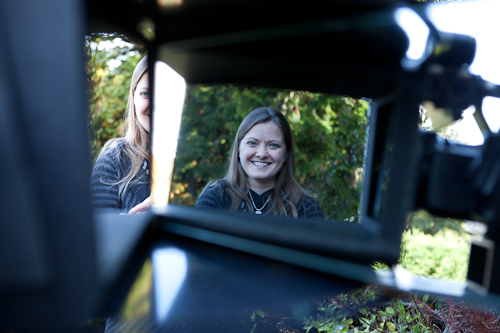
Three Guatemalan females, students of Population Council’s participatory film program, create a short segment practicing their production skills.

Finally, we were told of the Council’s creative efforts to develop community intelligence to protect girls with the advent of another project called  ‘Violence Mapping’.  Females in the program are armed with GPS devices to collect data on the households in their communities.  Maps generated from this data identify both safe and danger zones with a goal of creating future safe public shelters for girls in these communities.

This was an enlightening day, a positive day to see the work that is being done by women for women here.  These brave women son muy capaz and real change is possible.

Indigenous young women as change agents against violence in Guatemala

The high prevalence of gender-based violence in Guatemala leaves Mayan women and girls living in poor and isolated communities particularly exposed to risk. In a powerful approach to empower indigenous young women as agents of change in their communities, Population Council Guatemala, with support from the UN Trust Fund to End Violence against Women, is pairing them with mentors from local organizations, to engage them in a range of prevention activities.

Among other things, the girls undertake GPS-based community mapping, plotting every household, building and route to produce maps that show where girls and women feel safe or at risk. The maps are making young women and their safety concerns visible for the first time, catalyzing community-wide discussion about violence against women and girls and ways the community could come together to prevent it. In addition, Population Council is training a cadre of girl leaders in participatory video to highlight issues of gender and violence in their communities.

The UN Trust Fund to End Violence against Women, administered by UN Women, is a leading source of support for efforts to end violence against women and girls across the world. You can join this vital work by donating to the UN Trust Fund and by taking action at Say No – UNiTE to End Violence against Women.

Posted

Editor’s Note: Stirring the Fire comes to you from Guatemala where our team is producing a documentary about how Population Council Guatemala is preventing violence against Mayan women.  STF team member Kara Marnell reports from the field below.

Irma Catú is one of the Social Change Agents currently interning with the Defensoría de la Mujer Indígena (DEMI- Office for the Defense of Indigenous Women) in Quetzaltenango.

A tragic human rights crisis is unfolding in Guatemala, a country with a grim history of violence and decades of civil war, as abuse against women continues to grow at horrifying rates.  According to the United Nations, nearly 45% of Guatemalan women have suffered some form of violence in their lifetime and cases of rape, torture, and even murder of females are widespread. While a corrupt patriarchal society rooted in inequality may have tolerated and enabled such injustice, global advocates have moved to reveal the stories of these victims and to begin to combat the brutality endured by Guatemalan women and girls.

The challenge to replace stories of abuse and oppression with those of equality, respect and peace is nearly overwhelming, but change in Guatemala, as demonstrated in other countries, is never impossible but begins with revealing the bitter truth. Phil Borges, a renowned social documentary filmmaker and photographer, will lead this trip, along with a dedicated and talented team of researchers, to assist in the process of documenting, recording and filming the stories of these women. Rajesh, Mixtli, and I will assist with the filming, photography, and social media of this project with the goal to expose these tragedies and give voice to the marginalized and oppressed.

As we embark on this incredible journey, we are thrilled but can barely begin to understand how this experience will influence all of our lives but, more importantly, the hopeful impact it will have on those we meet. We are prepared to add a voice for the victims, who are mothers, daughters, sisters and nieces and to stand up, and influence discussion and debate and to help protect these women and girls who have been marginalized and their treatment ignored for far too long.  We expect to be a part of promising change in the lives of these women and the future of their daughters.

During our journey, we will update the Stirring the Fire blog with regularly reports about our interviews and our findings along the way.  Continue following this blog to learn, along with us, more about Population Council Guatemala’s programs serving our Guatemalan friends.

-Kara Marnell

Indigenous young women as change agents against violence in Guatemala

The high prevalence of gender-based violence in Guatemala leaves Mayan women and girls living in poor and isolated communities particularly exposed to risk. In a powerful approach to empower indigenous young women as agents of change in their communities, Population Council Guatemala, with support from the UN Trust Fund to End Violence against Women, is pairing them with mentors from local organizations, to engage them in a range of prevention activities.

Among other things, the girls undertake GPS-based community mapping, plotting every household, building and route to produce maps that show where girls and women feel safe or at risk. The maps are making young women and their safety concerns visible for the first time, catalyzing community-wide discussion about violence against women and girls and ways the community could come together to prevent it. In addition, Population Council is training a cadre of girl leaders in participatory video to highlight issues of gender and violence in their communities.

The UN Trust Fund to End Violence against Women, administered by UN Women, is a leading source of support for efforts to end violence against women and girls across the world. You can join this vital work by donating to the UN Trust Fund and by taking action at Say No – UNiTE to End Violence against Women.
Posted

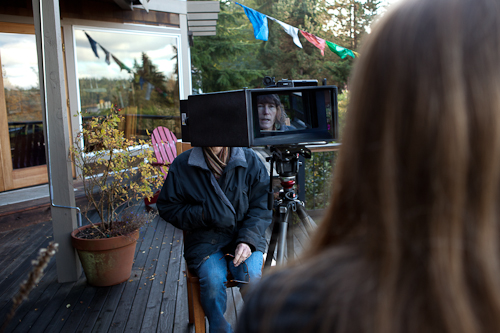
I like the subject to look as directly into the camera as possible when being interviewed. This has proven to be a difficult thing to achieve. One of the ways I have attempted this is to use a long focal length lens and place the camera behind the interviewer and slightly to his or her side. This has its limitations. For one the subject is still not looking directly into the camera even though the parallax has been greatly reduced. Also unless the interviewer is very still there is a chance that they will pop into the frame from time to time as they engage the subject.

Today I’m going to try a simple solution from VFGadgets called from EyeDirect.

It’s a cold winter day in Seattle but I wanted to see how this would work outside with a lot of light coming in from all directions. I’m glad I did this test before committing to take the rig down to Guatemala next week for a film on Violence against Women for the UN.

I learned that the interviewer has to appeared dead center in the mirror or the slight shift in the subject’s eye contact was noticeable and distracting. It would have been better to have the typical off camera eye contact.

The EyeDirect unit is built like a prototype and could use a lot of refinement, especially considering its $1500 price tag. It’s rather clunky to set up—needs an allen wrench to make adjustments and set up instead of knobs or wing nuts.

The mirror tilt adjustment knob did not hold the adjustment and I had to use waded up tape to hold the mirror tilt adjustment.

After using it on two subjects their comments were– it did take a little while to get used to talking with a disembodied head in the mirror but after a few minutes they forgot about it.

Here are the results.

Conclusion: Although a bit clunky I will probably rent the unit for the Guatemala film. If anyone knows of a better solution please let me know.

Posted

Tarchin 40--Kailash Kora

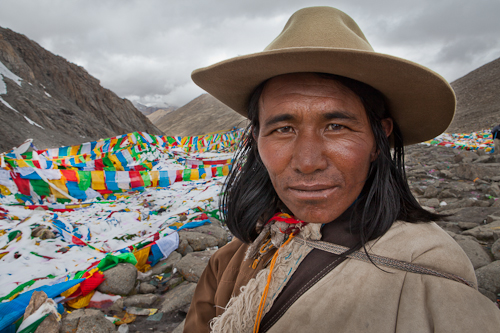
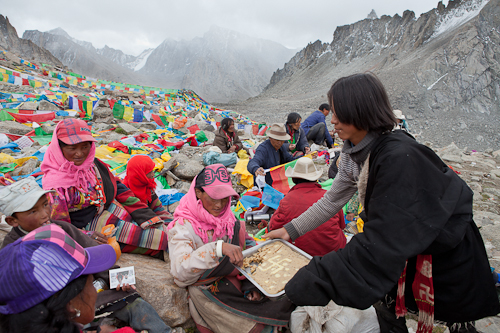
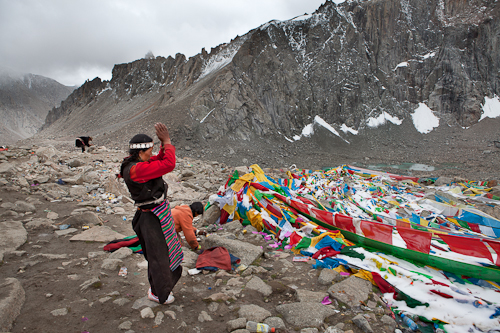
The Buddhists, Hindus, Jains and Bonpo regard the sacred Mount Kailash as the heart of the world.  One full circumambulation around the thirty-two mile trail around the mountain is said to erase the sins of a lifetime.  Pilgrims on this kora will leave cherished personal items behind like a piece of clothing, a braid of hair or even a tooth to symbolize their death and rebirth.  While on the journey they contemplate the nature of impermanence by taking time to imagine their own deaths.   In actuality the Kailash Kora claims a few lives every year.  While it took me three days to complete the full kora many Tibetans are able to do it in a day.

Pilgrims on Dolma La Pass--Kailash Kora

At 18,500 feet the Drolma La Pass is the highest point on the Kailash Kora and is known as the “hill of salvation.”  The pass offers every pilgrim the possibility to be cleansed of all previous sins and a transition from their old life to a new one. 

Pilgrims on Dolma La Pass--Kailash Kora

Posted

Our book TIBET: Culture on the Edge was just released this week!!   I must say I’m thrilled with how it turned out.

The idea for a second book on Tibet came quite by accident.  ( My first book Tibetan Portrait was published 16 years ago.)  In 2009 I had traveled to Lhasa to document the work of the US based organization OneHeart that was working to reduce the high rate of maternal mortality on the Tibetan Plateau.

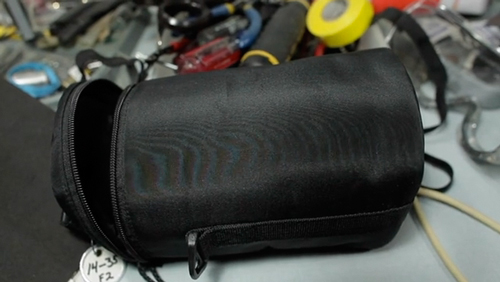
My equipment in the bag on the left.

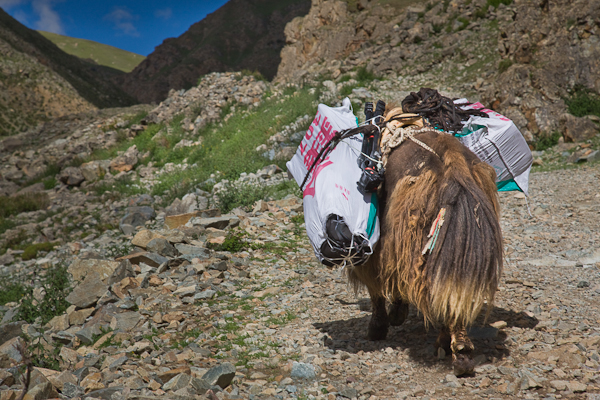
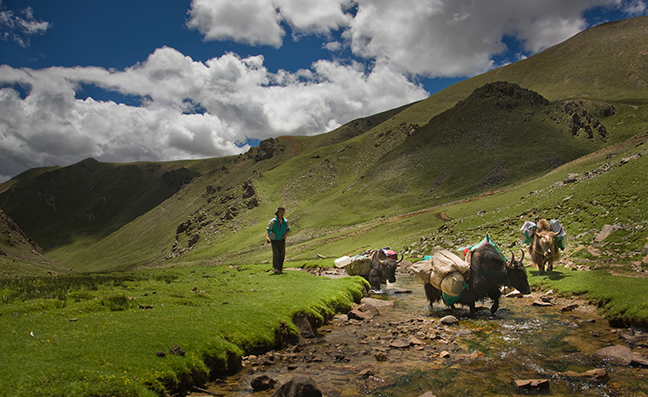
Unfortunately, because of the riots that had taken place in Tibet just before the 2008 Olympics China decided to shut down all foreign non-profit organizations in Tibet.   I arrived and soon learned I had nothing to do!   Since I was already there I decided to take a trek I had always wanted to do so I hired a guide and a couple of yaks and headed out.   Almost three years later I have a book in my hands!

It's always tense crossing water. Yaks like to cool off by laying down in the water.

Birthing a photo book is definitely a labor of love.  After spending eighteen months collecting the content I’m usually faced with at least a year of postproduction editing, researching, writing and designing.  In this case the process went ever so smooth thanks to my agent John Campbell who introduced me to a wonderful production team at Rizzoli.  Most heartfelt thanks to Jim Muschett and Melissa Veronesi for editing and hassle free project management.  I want to give special thanks to Susi Oberhelman for her beautiful design.  It was so amazing that we all saw eye to eye 99% of the time.  Truly a wonderful experience for me.

Posted

The typical way I work when producing a book is to choose an issue I feel strongly about then finding an organization (usually an NGO) that is aligned with the same interests and partner with them to collect the content necessary for the book.  The partnership is not only valuable in helping to cover the costs of travel but in providing access to the subjects I’m illustrating.  After we have collected the images and text I usually shop the content and theme of the book as a package around to different publishers.

Jinzhu Road—went from 2 lane road to 6 lane divided highway in 15 years

My book TIBET: Culture on the Edge that is to be released this October 4th, took a different course.  Rizzoli, the publisher of three of my previous books, approached me and asked if I would consider doing another book on Tibet.  My first book with Rizzoli Tibetan Portrait in ’96 had done very well and they wanted a book with a general theme of ‘Tibet 15 years later’ through my eyes.  Tibetan Portrait’s theme concentrated on the Tibetan’s struggle to maintain their Tibetan Buddhist Culture in the face of occupation by a foreign culture.

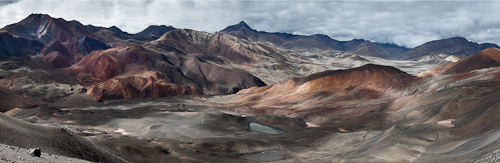
Desertification on the Plateau

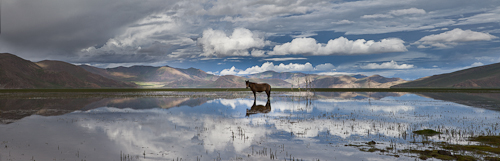
My trip to Tibet after a 15 year absence was absolutely shocking to me!!  The amount of development that had taken place in that short time was unbelievable.  Furthermore, the evidence of climate change became very real for me as I crossed from the most eastern part of the Tibetan Plateau to the most western border.  The Tibetan Plateau is heating up twice as fast as the global average and my interviews with the nomads and farmers confirmed the speed at which the climate is changing there.

Flooding Caused by the Rapidly Melting Glaciers

I found the one constant that had not changed was the devotion of the Tibetan People to their spiritual practice.  So the theme of TIBET:  Culture on the Edge revealed itself during the year and a half I traveled across the plateau.  The book became about a culture struggling to survive in the face of massive technological and developmental changes all the while trying to adapt to the displacement caused by the changing environment.

Potala Palace on Display

Posted

I shoot my documentaries with both the Sony EX1 and the Canon Mark II 5D. I love the 5D for the shallow depth of field I can achieve with a variety of lenses. It has some very definite ergonomic issues so I mainly use it on a Tripod. I often set it up as a second camera on my interviews.

During my recent trip to Liberia, there was one issue that was constantly bothering me and limited my use of the 5D. In many situations I get those annoying moire patterns and aliasing artifacts.

Example of Moire

I’ve just heard that there is a fix although fairly expensive. It is the VAF-5D2 filter. The cost is $375 and ¼ stop of light lost.

If you want to know more about it go to: http://store.mosaicengineering.com/

VAF-5D2 Filter

If anyone has had experience with this filter could you let me know? Other than the loss of ¼ stop of light I was wondering what would be the disadvantage of leaving it in all the time. It seems like it would be such a pain to have to stop and insert it every time you encountered moire or aliasing problems.

Posted

Kevin Castner reflects on his travels to document the work of Foundation for Women (FFW) in Liberia with Phil Borges and WTYSL.

My final reflections?  This was an actual adventure for me, something I’ve never done and well outside my comfort zone.  I missed not being able to ‘move’, since we always had to be ferried by car due to the location of our hotel.  Normally, I learn an area through my feet, but I was told it was too dangerous, etc. and besides we were always busy.  Anyway, that is something I’ll change next time.

Kevin in West Point Curiosity of WTYSL

I’ve learned a lot.  About myself.  That I should be careful about judging or drawing conclusions using only my own previous experience as a guide.  I’ve seen that people, kids in particular, can be extremely happy in extremely reduced economic circumstances.  Should we tell them they shouldn’t be happy?

I’ve thought a lot about Mama Liberia and her recent history.  I’ve jogged along her ocean beaches, seen her war-ravaged coastline, climbed through the guts of her former #1 hotel.  I’ve see her lush tropical beauty and I’ve read about her abundant natural resources, to which the cure/curse of oil may soon be added.  And my thought was and still is….how could you screw this up?  You had so much and it took such a short time to ruin it, to ruin your country and its progress and your children’s future.  HOW COULD YOU SCREW THIS UP?

Ducor Hotel, once one of few 5-Star hotel's in Africa, since the war has been extensively damaged.

But I’ve also thought about the ‘developed’ world I came from; the United States of America.  Liberians could ask us the same question writ larger.  About our carbon footprint polluting the world.  Our utterly wasteful habits it would be so easy to change.  Our obesity.  Our over leveraged financial system and white collar criminals.  What about Europe’s wars and financial crisis?  The Mid-East.  The kleptocrats running Russia?  The list is endless and includes every nation and region on earth.

The shell of the Ducor Intercontinental Hotel from West Point

What I take from these reflections is that homo sapiens, here in Liberia or anywhere else, have a lot to answer for regarding its stewardship of our planet.  We should do better.  And, if Liberia is also a testing ground for empowering women through microcredit and education and changing gender roles then I’ll all for it.  The male of the species has had over 5,000 years to prove they don’t deserve to be running things.  Let’s give the women a shot!

Kevin Leaving Women's Summit with Hawa, Behsheba and Theresa

Phil is now off to document another NGO in Liberia.  Check back soon to learn about the next project and keep a look out at www.stirringthefire.org for media from Phil once he is home!

Posted

Phil is in Liberia documenting the work of Foundation for Women (FFW), an organization that strives to continually support and encourage impoverished women, both globally and locally, by funding and creating microcredit programs. A longtime supporter of Phil and his work, Kevin Castner is traveling with him and reporting back to us from the field.

Curiosity of WTYSL

All the work of editing the 1 1/2 terabytes of images and video that Phil and Alicia, Sebastian and Philippa (of What Took You So Long) had taken was finally sculpted into a 24 minute film called ‘I Challenge Life’.  Sadly, the weather Gods and scheduling miscommunications prevented us from an outdoor premiere of our movie.  This morning we got permission from a local church and showed the film indoors. Unfortunately, of our girls, only Martha, Hawa and Asalyne were still local and available.  They were joined by the staff of Foundation For Women and 50-100 people from the local community.  I’m proud of the film and it conveys the messages we wanted: concentrate on your education, never give up on your dreams, and don’t compromise your long term future by taking short cuts.  The film gets a nice round of applause.

The Church Where 'I Challenge Life' Premiered

This last day of our trip is a time for sad good-byes and reflections.  I actually didn’t get a chance to say so long to Phil, succumbing to a bad cold and sore throat after his herculean labors.  One minute he was next to me, the next gone, on the way to the airport to pick up his next assistant.  They’ll stay in Monrovia for two more nights then take a UN helicopter east to rural Grand Gedeh.  I’ll probably see him next in Seattle in the USA.

'I Challenge Life' Showing!

The ‘What Took You So Long’ tribe have insinuated themselves into my heart and I’ll miss them all.  Even Alicia, who suffers from the same chronic disease that afflicts Phil.   As hammers see everything as nails, photographers see everything as images and videos that must be shot and reshot, that require different lenses, different light, etc.  If they weren’t so passionate (and the end results so compelling) they wouldn’t have any friends (or assistants!).  As it is, they are quite lovable, charming and fun to hang out with.  If they had as much fun with me as I have had with them, then we all had a good time.

I also said good-bye to Moses, our 13 year old camera assistant.  As a going away present I gave him a deck of cards and showed him a few ways to shuffle a deck.  A half hour later, while we were setting up for the film, I found him in the back of the church playing a game with Asalyne.  I asked him what it was called and he flashed a wide grin and said, “AK-47”.  How fitting.

Asalyne Browne and Moses Playing AK-47

I said good-bye to the folks at FFW, especially Emily Peal.  My opinion after three weeks is that Emily always had a big heart, but somehow since she came back to Liberia it has just continued to grow and grow.  I think she is one of the most wonderful, understated individuals I have ever met.

We dropped off Deborah at her terminal and then our constant guardian angel, Arthur Tamba, on loan to FFW from the Liberian Vice President’s security detail, gave me my last friendly good-bye.

We have a bonus post from Kevin for you next.  Check back to read his personal reflections about this experience.

Posted

Phil is in Liberia documenting the work of Foundation for Women (FFW), an organization that strives to continually support and encourage impoverished women, both globally and locally, by funding and creating microcredit programs. A longtime supporter of Phil and his work, Kevin Castner is traveling with him and reporting back to us from the field.

“What God has joined together let no man put assunder.”  I photographed this on a poster in a Sinkor living room.  Mama Liberia is very religious but the misspelling of the final word, coupled with ‘man’ earlier, also gives an unintended history lesson.  Tribalism and greed, fueled by power and testosterone did indeed bring this country ass-under.  Now, it is clawing its way back, a few rock piles and charcoal sacks at a time.

'Let no man put assunder' Poster

We hit a great trifecta when finishing the our last of our interviews while documenting the work of FFW.  First up was Monica Flanjay, the center chief for both Fanta Town Matadi and New Matadi.  She takes us into her home, down a hallway, and we sit, surprisingly, on part of an old, solid oak furniture set.  There is history in this house.  It has painted walls with pictures.  There are lace curtains shading the light coming through the barred windows, and a TV in a corner.  There are real windows, and the rooms have doors.  Of course, another part of its history also shows.  The electrical sockets are empty and the home is dark; the only light is natural.  There is a landline telephone, the only one I have ever seen in a private home.  I ask Monica if it works and she gives me the answer I’ve heard from many Liberians on similar topics, “Before the war……”.  Monica used her first loan to buy cold water.  Now, in the rainy season she sells charcoal.  She takes us to her warehouse, tells us she buys 200-300 bags at a time.  Her success means she only sells wholesale, doesn’t have to break big bags into little bags.  She’s moving up market.

Monica Flanjay's Charcoal Warehouse


After our talk we thread our way through her neighborhood, which she estimates at 15,000 people or so, and I reflect on the speed of my changing perceptions.  Three weeks ago I might have been put off by the dirt, or lack of light, or the rundown furniture and shabby, many times repaired, faded cushions.  But after the squalor of West Point the ‘grinding poverty’ I described so long ago when I first arrived now seems middle class, and Monica’s home a veritable oasis.  As I am reminded again and again, everything is relative.

At New Matadi we sit down with Angeline Reeves.  She was introduced to Foundation For Women by Korpo Zayzay, the center manager for Fanta Town (together the ‘Matadi’s’ have 45 women in the program).  Angeline has been in the FFW program for over a year and she describes exactly what she’s done with her loans.  She used her first, 6,000 Liberian Dollar (LB) loan to buy dried fish and sell them around her neighborhood.  She paid that off and borrowed 9,000LB and got into the timber (‘plank’) business with her fiancé, who lives in the bush.  She paid off that loan and borrowed 12,000LB (about $170USD) which she has used to buy inventory to stock a storefront selling fabrics on the local high road.  Angeline is a serial entrepreneur.

Angeline Reeve's 'High Street' Fabric Shop

Next, we drive to Wroto Town.  I’ve been here before and it is nice to meet Felicia Shipper again, the center leader.  She is bright and articulate, humorous and out-going.  She is such a natural leader, in fact, I wonder what she could have done if she had had other opportunities.

Phil Interviewing Felicia Shipper

All three of these women have used their FFW loans to improve their lives, the lives of their families, their communities, and send all their respective children to school.  At least two of them are going or planning to go to University themselves and get degrees.  The FFW loans have done far more than just help these women feed their families.  The loans have given them self-confidence and helped them to dream (their word) of a better future they can help themselves and their country achieve.  These women have every right to be proud.

Next read about the video WTYSL and Phil Borges produced with the FFW Young Women Leaders as Kevin reports on wrapping up their time documenting FFW!