Stirring The Fire

Posted by & filed under Stirring The Fire.

“If you educate a man, you educate an individual.
If you educate a woman, you educate a family.”

-African Proverb

I had the privilege of working with women and girls in Southern Sudan during the summer of 2010. During that time, I conducted lots of interviews which I later transcribed, wanting to hear more about their lives, about their hopes, dreams and concerns, and ultimately share them with folks at home. This was their gift to me. I now pass it on to you. [Note: Interviewee’s name has been changed.]

A frank expression.

My name is Sofia. I don’t know how old I am. I have seven children and my oldest is married and has a child who is two years old, so that makes me a grandmother. My youngest child is 9 years old.

My husband has five wives and I am his second. He struggles to give enough to all his wives and children so I need to support my kids on my own and opened up this shop. It used to be a complete restaurant and not just a tea shop. But 8 months ago the items I used to supply the restaurant along with all my sorghum inventory were stolen. The thieves were never found so now I just have a tea shop.

Market Place

I stayed in Southern Sudan during the war. I stayed in a village close by while the Arabs invaded, took our cows our goats and burned our houses and crops to the ground. We hid for 14 weeks though my family was not immune from the consequences. My second oldest daughter was captured by the Arabs. Another Sudanese woman, who herself had lost all her children in the war, was with my daughter and was able to care for her during the three months of her capture. My daughter came back to me and I was so happy.

Four of my children are in primary school levels 1,3,4 and 7. I want my children to continue their education. I myself never went to school.

A normal day for me includes waking up at 6am, bathing, checking in with my children to see if they need anything. They are old enough to help out with the chores like fetching water, sweeping, washing clothes and cooking, so I don’t have to do so much anymore. I open the shop at 7am close the shop at 6pm to go home. The only time I have off is early Sunday morning when I go to church and pray. Otherwise I’m at the shop 7 days a week.

Daily Life

I look forward to increasing business after the Referendum because, if it is peaceful, God willing, more people will return to this area especially from the North. If we can separate peacefully without fighting more children will be educated without the drastic interruptions and devastation war brings.

Posted by & filed under Stirring The Fire.

The movement for women’s and girls’ empowerment requires commitment from all of us, including men.  Men’s participation in this movement is increasing around the world creating solid and sustainable efforts toward gender equality.

Men are also powerful allies in the movement.  Take for instance former President Jimmy Carter, founder with wife Rosalynn, of The Carter Center.  The Carter Center’s overarching goal is to advance universal human rights and alleviate human suffering.  Throughout its work, the Center has encountered the reality that women are majorly second class citizens.  Carter himself acknowledges that world religions play a significant role is this.


Former President Jimmy Carter with wife Rosalynn
Credit: Emily Staub/The Carter Center – Nasarawa North, Nigeria

In 2009 Carter gave a compelling speech to the Parliament of the World’s Religions, revealing that the status of women today is in part sustained by world religions’ beliefs in the subordination of women.  He himself is a life-long Christian and staunch advocate for women’s right to equal treatment.  He effectively exemplifies that a man can be both of these things, fully and without compromise.   After decades as a member, Carter disassociated from the Southern Baptist Church in 2000 in part because of its mandate for women’s submission.  By comparing the Declaration of Human Rights and pieces of the Holy Bible, Carter simultaneously points out those perpetrating women’s oppression and points to solutions.

In Jimmy Carter’s own words:

This view that the Almighty considers women to be inferior to men is not restricted to one religion or tradition. Its influence does not stop at the walls of the church, mosque, synagogue, or temple. Women are prevented from playing a full and equal role in many faiths, creating an environment in which violations against women are justified.

The truth is that male religious leaders have had – and still have – an option to interpret holy teachings either to exalt or subjugate women. They have, for their own selfish ends, overwhelmingly chosen the latter.

Their continuing choice provides the foundation or justification for much of the pervasive persecution and abuse of women throughout the world. This is in clear violation not just of the Universal Declaration of Human Rights but also the teachings of Jesus Christ, the Apostle Paul, Moses and the prophets, Muhammad, and founders of other great religions – all of whom have called for proper and equitable treatment of all the children of God. It is time we had the courage to challenge these views and set a new course that demands equal rights for women and men, girls and boys.

As a follow up to his speech, listen below as Carter urges religious communities to promote, not hinder, women’s rights during his opening remarks at The Carter Center’s 2011 Human Rights Defenders Forum.

Carter, like other male allies such as Nicholas Kristof, Phil Borges and Ted Turner, is an influential figure in the global movement toward women and girls’ equality.  He concludes with a call to action each of us needs to hear, and heed:

“…we are calling on all those with influence to challenge and change the harmful teachings and practices – in religious and secular life– that justify discrimination against women and to acknowledge and emphasize the positive messages of equality and human dignity.”

Posted by & filed under Stirring The Fire.

My name is Danielle Prince and I volunteered the summer of 2010 with The Valentino Achak Deng Foundation.  How can I sum up all the pieces of my experience in Southern Sudan during my 5 weeks there?   I am forever touched and changed by the women and girls I worked with.  Despite the intense heat, cornucopia of bugs and other flying creatures, and relative ‘slowness’ of how things happen – or maybe because of these things – my time there was shaped and nurtured not only by the environment (so different than Seattle), but more significantly by getting to know the girls at the secondary school as well as some of the women in the market.

Me hanging out with the girls on market day.

My two projects (and their off-shoots) ran parallel: creating a girls’ club that metamorphosed into individual one-on- one interviews that I then got to write up and present to the Foundation; creating and facilitating a women’s group on the weekends for the tea-shop owners in the market.  While both were distinct, each lent a glimpse into the lives of women in Southern Sudan: what their hopes and dreams are, what they hold dear, what issues they face as problematic and challenging.

The weekly Women’s Group meeting.

After I had worked with the market women for a while, they gradually started to open up.  Here’s a few of the questions they began to ask me after a while:

Do American men accept having a baby girl (are they happy for it)?
If your husband divorces you, can you still have and raise a child?
If you have a child out of wedlock, what can you tell that child?
Why do men in America marry only 1 wife?
In America, can a woman leave an abusive husband with her children or does she have to stay?
Do you have women working in tea shops or in big companies in your country?

The women and girls told me specifically that they want people to know about them:  they want you, Reader, to know about them.   I remain committed to raising awareness about their lives and a strong advocate in portraying them as they are: resilient individuals who are taking charge of their lives by pursuing education, creating livelihoods and being on the forefront of a rapidly changing nation, rather than simply victims of war, politics and erratic aid efforts.

Tea shop owners.

You can read more about my experience in Stirring the Fire’s “How Others Got Involved” section.  I will also be contributing on an ongoing basic to Stirring the Fire’s website and blog!  Stay tuned for upcoming posts of my interviews with the women and girls in Sudan as well as my other volunteer experiences.

Update:  Interview of one of the tea shop owners here!

Posted by & filed under Stirring The Fire.

Most of my human rights work in the developing world has been focused on creating media (exhibits, books, and multimedia) for audiences in developing countries.  Typically I would create media for NGOs that would put it to use for building awareness and fund raising campaigns in North America and Europe.

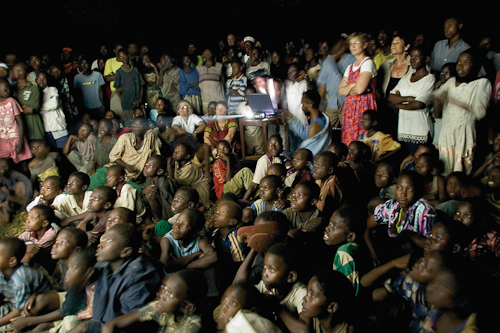
At the same time I had formed a non-profit organization (Bridges to Understanding) whose mission was to give students in remote communities a voice by teaching digital storytelling.  Bridges worked with middle and high school students in India Peru, Guatemala, Kenya, South Africa and Cambodia and gave them a voice by showing them how to upload their stories on the web and share their lives with students in the U.S.   As part of the process we would have the indigenous students present their finished multimedia story to their own community.  For me it was the highlight of the trip.  In Takaungu, Kenya we got a generator and held an outdoor movie night so the students could show their movie to their village.  The crowd went wild and cheered for the film to be shown over and over again.

I just became aware of the organization Tostan’s efforts to address the issue of female genital cutting in Senagal by helping the locals create a film intended for their local community.  Check out Walking the Path of Unity

As I continue to work with media in the developing world I am planning to go in this direction.  I hope to take two to three photojournalism/ film students with me on trips as we help communities in the developing world create their own media for public awareness campaigns targeting social and economic gender issues.

Posted by & filed under Stirring The Fire.

Through my Bridges to Understanding program I have enjoyed teaching digital story telling to students in different countries. I wanted to give them an opportunity to share stories of the issues they faced in their communities. So I was excited when I heard of the work that Anne Medley did in the Congo.

The following is a synopsis of Anne’s experience. Read more about her compelling story by following this link.

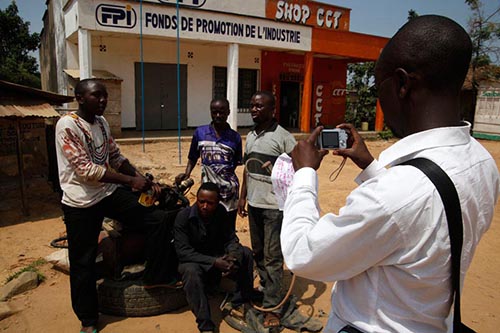
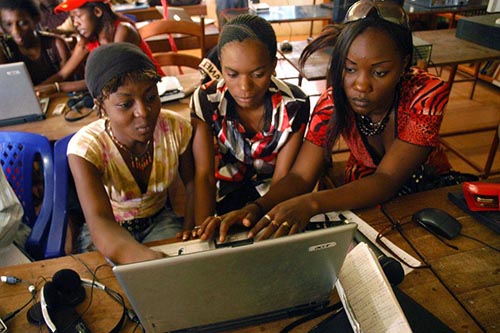
For three months, I taught multimedia journalism — photography, audio and video — to Communications students studying at the Université Chrétienne Bilingue du Congo (UCBC) in the city of Beni in North Kivu province as part of an entrepreneurial education project called “Congo in Focus.” Many of my students had never used audio recorders or video cameras before; few knew about journalism. Yet after several months of hands-on training, they produced great multimedia stories about their community.

So often, foreign journalists in DRC report solely on war, violence against women, poverty and disease. By giving students at UCBC the tools and skills to tell the stories THEY wanted to tell about their communities, I felt like I was helping to empower them not only to expose corruption in their country but also to shed light on the positives.

To feature the students’ work, I created a website (www.congoinfocus.com) where their photo/audio slideshows, videos and blog posts could be viewed. All equipment that I took with me to Congo was donated to the university’s Communications department to enable students to continue telling their own multimedia stories long after my departure.

I initially connected with Congo Initiative (CI) through a friend whose brother worked at the Université Chrétienne Bilingue du Congo (UCBC) in North Kivu province.  I funded my trip through personal savings and donations from family and friends.

My goal is to use my skills in photojournalism and multimedia journalism to aid organizations doing “good” in underrepresented parts of the world. I also want to continue implementing projects like “Congo in Focus” in post-conflict zones around the world.

Anne Medley with Congolese students.

Posted by & filed under Stirring The Fire.

On August 15th the Stirring the Fire exhibition made its debut at the Joan B. Kroc Institute for Peace and Justice at the University of San Diego.  Don’t live in San Diego?  Not to worry, here are some photos of the show!

If you do live in San Diego the exhibition will be up through December 15th.  Do you happen to know a USD student?  Be sure to tell them about the Stirring the Fire Fellowship Opportunity to do an international study, volunteer, internship or service learning project that focus on the issues women and girls face.  The deadline is December 17th.  And if you have seen the show, please let us know how you liked it!

Posted by & filed under Stirring The Fire.

How is the global movement to empower women and girls advancing?  The United Nations Statistics Division recently released The World’s Women 2010 which shows that progress towards gender equality has been made in some areas, such as school enrollment, health and economic participation. At the same time the report shows that much more needs to be done to close the gender gap in critical areas such as power and decision-making and violence against women.

In light of our recent election where, despite the women elected, the US had a record number of women who ran for office, here are the findings regarding power and decision-making taken from the Executive Summary:

Around the world, a lack of gender balance in decision-making positions in government persists.  Women continue to be underrepresented in national parliaments, where on average only 17 percent of seats are occupied by women. The share of women among ministers also averages 17 percent. The highest positions are even more elusive: only 7 of 150 elected Heads of State in the world are women, and only 11 of 192 Heads of Government. The situation is similar at the level of local government: female elected councilors are underrepresented in all regions of the world and female mayors even more so.

In the private sector, women are on most boards of directors of large companies but their number remains low compared to men. Furthermore, the “glass ceiling” has hindered women’s access to leadership positions in private companies.  This is especially notable in the largest corporations, which remain male-dominated. Of the 500 largest corporations in the world, only 13 have a female chief executive officer.

Wondering which organizations are working towards gender equality in government and business?  Check out The White House Project, part of the Stirring the Fire “Take Action” database:

The White House Project, a national, nonpartisan, not-for-profit organization, 501(c)(3), aims to advance women’s leadership in all communities and sectors, up to the U.S. presidency. By filling the leadership pipeline with a richly diverse, critical mass of women, we make American institutions, businesses and government truly representative. Through multi-platform programs, The White House Project creates a culture where America’s most valuable untapped resource—women—can succeed in all realms.

The World’s Women 2010 also highlights the differences in the status of women and men in population and families, health, education, work, violence against women, environment and poverty.  Check out the rest of the report to read about all the key findings!

Posted by & filed under Stirring The Fire.

At the beginning on the month the United Nations General Assembly voted unanimously to create a new entity to accelerate progress in meeting the needs of women and girls worldwide.  UN Women combines the resources of four previous branches of the UN that focus on gender equality and women’s empowerment and will be operational by January 2011. 

Taken from a statement by the UN Secretary-General, Ban Ki-moon:

“UN Women is a recognition of a simple truth: Equality for women and girls is not only a basic human right, it is a social and economic imperative. Where women are educated and empowered, economies are more productive and strong. Where women are fully represented, societies are more peaceful and stable.”

What an incredible development!  It will be exciting to watch the impact that UN Women will make.  We look forward to tracking the inevitable accomplishments of this unity.

Posted by & filed under Stirring The Fire.

Though paying and accepting dowry has been illegal in India for 40 years it is unfortunately still all to common.  Strong enforcement of the Anti-Dowry Act, which has been around since 1961, doesn’t exist and bride burning and female infanticide remain a real problem for women and girls in various South Asian countries.   

According to an BCC article “Indian Government statistics show that husbands and in-laws killed nearly 7,000 women in 2001 over inadequate dowry payments.”

In Dharahara village, India, the families have found their own solution around this unfortunate tradition by planting trees to celebrate the birth of a girl.  Read more here.

Ideally there would be an end of dowry deaths, bride burning, and female infanticide all together.  Until then, the people of Dharahara have prevented a single violent dowry or infanticide incident.  It is an evolutionary way around the practice so instilled in their culture.    

Are you familiar with an organization working against dowry deaths, bride burning, and/or female infanticide?  Please share them with us!

Sri Lanka is another country faced with these particular challenges.  Watch (click on full video) how Dr. Chandini Perera is empowering women in her country.

Posted by & filed under Stirring The Fire.

“Women make change, but not in circumstances of their own choosing. They have to negotiate. They have to subvert tradition that once silenced them in order to give voice to new aspirations. . . We can use our tradition to navigate change.”

Ted Talk by Kavita N. Ramdas, president and CEO of the Global Fund for Women

Kavita tells the stories of three amazing women that have taken part in the global movement to empower women and girls by embracing and integrating their tradition and culture into their efforts. 

Global Fund for Women

The Global Fund for Women is a nonprofit grantmaking foundation that advances women’s human rights worldwide. We are a network of women and men who believe that ensuring women’s full equality and participation in society is one of the most effective ways to build a just, peaceful and sustainable world. We raise funds from a variety of sources and make grants to women-led organizations that promote the economic security, health, safety, education and leadership of women and girls.