Stirring The Fire

Posted by & filed under Stirring The Fire.

Multimedia storytelling empowers individuals and organizations; When used correctly it can inspire entire movements, bring communities together, raise awareness about social justice issues and give nonprofits a vital tool to amplify their message.

It’s for these very reasons and due to the overwhelming response for our social documentary internships that Stirring the Fire would like to announce our new multimedia workshops.  STF workshops will serve to help nonprofits that work to promote gender equality, to tell their story and give them online strategies to get that story in front of the audience they need to reach.

The workshops will differ from the internships in that there will be formal production and post production training.  Our founder Phil Borges explains briefly, “more and more nonprofits need multimedia, so I’ve decided to do these multimedia workshops to provide formal training in storytelling, film, photography, audio, editing, post production, and distribution.”

Our next workshop will be July 13-22nd in San Diego working with Foundation for Women, an organization that changes lives through microcredit finance, and by encouraging entrepreneurship as the solution to eliminating poverty.  We will be documenting their US microcredit programs, but focusing on their San Diego loan groups.  Apply here!
Posted by & filed under Stirring The Fire.

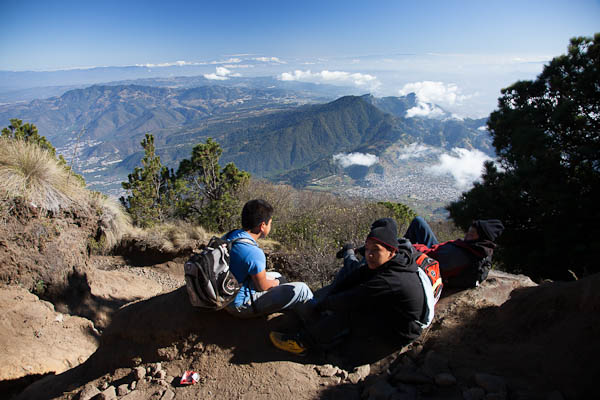
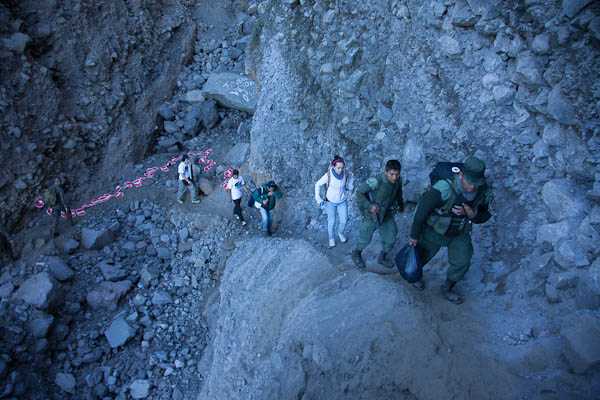
I managed to finagle my way onto the walk up the Volcano de Agua.  We set out at 4:00am to catch the buses from Antigua to the town of Santa Maria  where the hike began – at 5:30 we started the hike up the volcano.

One of the narrower parts of the trail

The altitude, terrain and number of participants made for a hike that was fairly strenuous.  As I was walking I found it interesting and encouraging that the majority of the participants were men since this was an event to bring about awareness to and reduce domestic violence.

Above the clouds

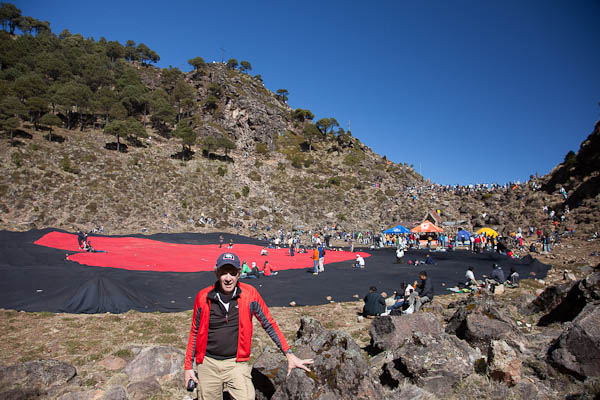
After about 4 hours I made it to the top where people were waiting for the announcement to create the human chain.  There were plenty of reporters and helicopters with film crews to document the event.  Spread out across the crater was a gigantic piece of nylon with a huge heart printed in the middle of it.  Everyone gathered around, picked up the canvas and began to wave it up and down.

Preparations to form the heart in the center of the crater.

At the heart of the crater

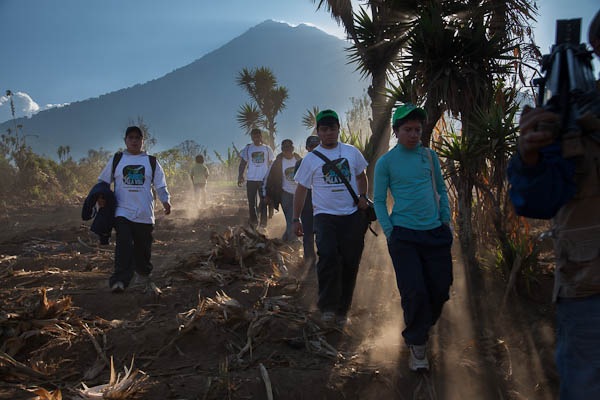
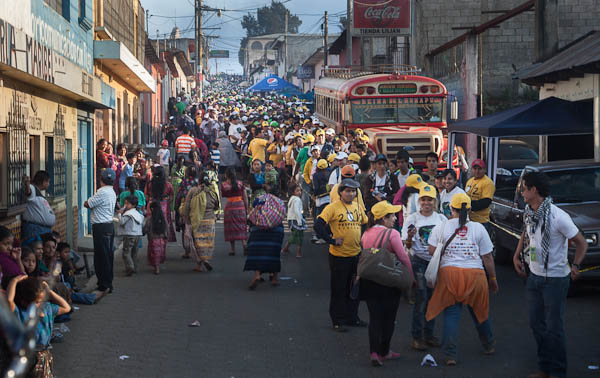
Further down the volcano thousands of people lined up to pass a flag up the mountain to the crater.  The trip down with thousands of people trying to negotiate a mostly one lane path, in addition to the dust they created made for a very long and uncomfortable descent.  Once we were back in Santa Maria the number of people that took part in this event overwhelmed the busses that were designated to take them back to Antigua.  I understand that some people waited about 3 hours for a bus.

The dusty trail

The masses waiting for a bus to return to Antigua

On a whole I commend the organizers – while there were many things that could have been done much better, the idea and the amount of work and organization to pull off something like this was still impressive. This event was organized by Ensena Amor: No Violencia (Teaches Love)

Posted by & filed under Field Apprenticeships, Stirring The Fire.

Editor’s Note: Stirring the Fire comes to you from Guatemala where our team is producing a documentary about how Population Council Guatemala is preventing violence against Mayan women.  STF team member Kara Marnell reports from the field below.

As I knelt down and searched the bright brown eyes of a little Mayan girl, I saw a future far different than what her eyes might see today.  I predict a future, filled with hope and opportunity, a girl who would know confidence and self-determination.

Young Mayan Girl

The town of Maya Kaqchikel is an indigenous community on the outskirts of the bustling city of Sololá.  Though it is a mere 20 minutes from Sololá, Maya Kaqchikel is free of tourists and shops.  Instead, its dirt roads wind between the ribbons of corn and working women with babies sashed to their backs decorate the landscape.

Maya Kaqchikel

The Stirring the Fire team had the pleasure of visiting this remote community on Saturday and meeting its warm and welcoming people.  The men and women stood side-by-side smiling as their young, excited children ran to greet us, some barefoot, others with clean but threadbare clothing.

In 2010, the community of Maya Kaqchikel became Population Council’s pilot community for its ‘Safescaping’ initiative, an effort to engage young female leaders to actively help determine what constitutes a “safe community” in answer to gender based violence and to help identify local paradigms that constitute various threats to girls’ safety.

Girls Who Participate in Safescaping Programing

As in many communities, the men here didn’t view themselves as the perpetrators of violence.  We’ve noticed time and time again that violence is so normal in these communities that it seems simply the way of life, the culture.  The community was reluctant to make changes fearing the admission that violence was a real problem.  Like so many issues, admitting there is a problem is the first step toward fixing it.  Ángel del Valle, the Monitoring and Evaluation Coordinator for Abriendo Oportunidades, explained how the community underwent 40+ hours of training and development to expose the common, everyday violence that women endure.  During the training, a powerful activity helped bring these issues to light and sparked an incredible change in the community.  First, the men and women were divided into two separate groups and given a tree.  Then, each group was asked to identify the “roots of violence.”  After completing their trees, the men and women came together and shared their differing perspectives.  The men saw violence (the little they perceived), as stemming from financial burdens and alcohol abuse.  The women, on the other hand, stood up for the first time, and declared that the females of the community worked twice as hard as the men and simply were not appreciated.  In response, a community leader, a man, rose and admitted that he had never realized that the women worked so hard.  Each day he returned home expecting dinner after a long day’s labor in the fields.  Yet, never before had he realized that the women were also working all day in and around the house, tending to the children and, even though they too were tired after a long day, they continued working to serve their husbands.
It was a breakthrough.

So simple, but so real.

All of this occurred a year ago.  Already, there has been a transformation and the community was proud to share their progress born of this understanding with our team. So, on this day, the community had prepared a series of reenactments to illustrate the violence that commonly occurred in the household and how the community had learned to tackle these tough issues.  How incredibly generous of this community to allow foreigners to see such a raw, open and rare view of itself.

Community Leaders in Traditional Dress for Reenactment

Violence against women is still a continuous battle here. Ángel thinks that domestic abuse still continues but an evolution, a revolution is beginning.  It’s not enough, he says, to simply create ‘noise among the girls’, but community focus and mobilization must occur for enduring change to take place.  This has been a community problem.   It takes a village to change the culture.

As we pulled away in the van, the men and women stood side-by-side thanking us earnestly for our visit.  It was then I realized that the men and women standing together was a symbol of their newfound sense of equality.  I waved goodbye to the little girl with bright brown eyes and thought that she now has a support group that many before her did not, the seed for a promising future.  A future taken for granted now in so many places far from here.  There’s hope for her.

Indigenous young women as change agents against violence in Guatemala

The high prevalence of gender-based violence in Guatemala leaves Mayan women and girls living in poor and isolated communities particularly exposed to risk. In a powerful approach to empower indigenous young women as agents of change in their communities, Population Council Guatemala, with support from the UN Trust Fund to End Violence against Women, is pairing them with mentors from local organizations, to engage them in a range of prevention activities.

Among other things, the girls undertake GPS-based community mapping, plotting every household, building and route to produce maps that show where girls and women feel safe or at risk. The maps are making young women and their safety concerns visible for the first time, catalyzing community-wide discussion about violence against women and girls and ways the community could come together to prevent it. In addition, Population Council is training a cadre of girl leaders in participatory video to highlight issues of gender and violence in their communities.

The UN Trust Fund to End Violence against Women, administered by UN Women, is a leading source of support for efforts to end violence against women and girls across the world. You can join this vital work by donating to the UN Trust Fund and by taking action at Say No – UNiTE to End Violence against Women.

Posted by & filed under Field Apprenticeships, Stirring The Fire.

Editor’s Note: Stirring the Fire comes to you from Guatemala where our team is producing a documentary about how Population Council Guatemala is preventing violence against Mayan women.  STF team member Kara Marnell reports from the field below.

During a powerful and eye-opening week of travel, interviews and filming in Guatemala, we have had the privilege to get to know several female leaders in various communities who are working hard to educate and change the lives of other females.  One group, in particular, is doing so creatively through the use of film.  This group, comprised of twelve girls between the ages of 15-23, has been learning about filming, editing, and using visual techniques to create and screen films that engage communities and urge discourse on the issues that affect females.  This ‘participatory film program’ is run by Insight Share, an organization with stations all over the globe.  Insight Share also collaborates with other groups, such as Abriendo Oportunidades, using this participatory video as a tool to teach young adults new skills in order to build self-confidence and educate women on the ways to stand up for themselves and to open doors of opportunity that might never have considered.

Soledad Muñiz, the associate country coordinator for Insight Share, explained how she has witnessed an incredible, gratifying transformation in these young women.  At one time hesitant to gather testimony on film, the girls now bravely take on the city, approaching strangers, seeking their opinions on various issues as if they are seasoned reporters.  Opportunities for woman are so woefully lacking in Guatemala that the participants view this program as a unique and exciting way to develop new skills and insights beyond any of their peers.   The girls also find power in their team.  They spend a month in training together, away from their families.  In fact, for some, it is the first time ever away from their families and that leads to ‘group trust’ and builds individual confidence, says Muniz.  These girls truly embrace all the program has to offer while still continuing their regular schooling, family responsibilities and their positions as girl leaders in their communities.

Hermelinda Teleguario, a 21 year old Guatemalan woman, faced our cameras to discuss the pressures that face teenage girls in her country, especially family pressures to marry at a young age, indeed, as early as 14 years old.   While Hermelinda is grateful to have a boyfriend that respects her and a family that allows her the freedom to marry whom and when she pleases, many other Guatemalan girls are not so lucky.   Some girls, even some of Hermelinda’s friends, find themselves married very young.  They soon have children and responsibilities they are not prepared to manage, neither emotionally mature or financially secure to assume.  By then it’s too late.   Still other girls see marriage as the only option to escape family situations and there is no escape at all.

Up Next: Alejandra Maria Colom is the program coordinator for the Population Council’s Guatemala office, overseeing “Abriendo Oportunidades” and maternal health projects.

Stirring the Fire has the opportunity to meet with Ms. Colom on Monday to discuss the issues that Guatemalan women face as well as the steps taken to combat the brutality endured by Guatemalan women and girls.

As we prepare for our interview with Ms. Colom, we would like to reach out to our followers. Do you have any questions you would like Stirring the Fire to ask about the social issues here in Guatemala?

Indigenous young women as change agents against violence in Guatemala

The high prevalence of gender-based violence in Guatemala leaves Mayan women and girls living in poor and isolated communities particularly exposed to risk. In a powerful approach to empower indigenous young women as agents of change in their communities, Population Council Guatemala, with support from the UN Trust Fund to End Violence against Women, is pairing them with mentors from local organizations, to engage them in a range of prevention activities.

Among other things, the girls undertake GPS-based community mapping, plotting every household, building and route to produce maps that show where girls and women feel safe or at risk. The maps are making young women and their safety concerns visible for the first time, catalyzing community-wide discussion about violence against women and girls and ways the community could come together to prevent it. In addition, Population Council is training a cadre of girl leaders in participatory video to highlight issues of gender and violence in their communities.

The UN Trust Fund to End Violence against Women, administered by UN Women, is a leading source of support for efforts to end violence against women and girls across the world. You can join this vital work by donating to the UN Trust Fund and by taking action at Say No – UNiTE to End Violence against Women.

Posted by & filed under Field Apprenticeships, Stirring The Fire.

Editor’s Note: Stirring the Fire comes to you from Guatemala where our team is producing a documentary about how Population Council Guatemala is preventing violence against Mayan women.  STF team member Kara Marnell reports from the field below.

Maria is full of grace.

At 24 years old, she might have been ‘ordinary’ except for the lifetime of suffering she has already endured and overcome at her young age.

Maria Chicoj’s mother died when she was the tender age of 12, leaving Maria, seven sons, another daughter, and a husband who struggled to support his family and turned to alcohol for comfort. The alcohol fueled domestic violence and Maria was his regular victim.  But she was never defeated.

Today, Maria is an advocate for women and adolescents as a Social Change Agent with DEMI (The Defense of Indigenous Women) in Quetzaltenango.  Self-assured and not much taller than most of her students, Maria scans her classroom, making eye contact with each one of her young female students as she discusses the stages of womanhood.   She wasn’t always this confident.  After her mother passed away, Maria dropped out of school and became the substitute mother for her seven brothers and younger sister, a nearly impossible job for a young girl but nonetheless an expected role.  After more than a decade of brutal beatings by her father, she made a decision to finally stand up for herself and create a different life, one of strength and dignity.

Hearing that DEMI was interviewing for an internship program, Maria found an excuse to leave the house and attend the interview.  She did so with considerable risk.  In fact, DEMI is an organization that is not supported by the Guatemala government and is otherwise not very welcome.  In fact, it’s routinely protested by men in Guatemala.  A day later after the interview, Maria was awarded the internship position.  It was the first time in her memory that she felt valued.

That was only a year ago.

What a difference a year makes in the life of one person determined to make changes.

Maria’s story is not an isolated one.  In Guatemala, women are among the most marginalized.  This human rights crisis is surging in Guatemala, a nation with a grim history of violence and decades of civil war, as abuse against women has reached a record high.  According to the UN, nearly 45% of Guatemalan women have suffered some form of violence in their lifetime and cases of rape and even murder is widespread.  While a corrupt patriarchal society rooted in inequality may have tolerated such injustice, global initiatives are dedicated to combating the brutality faced by these women and young girls.

The challenge to replace stories of abuse and oppression, such as Maria’s with respect and safety and confidence is daunting. But, positive change is possible one person, one household at a time through efforts to raise awareness about the issues women face and, in doing so, inspire others to join in the global movement to end gender inequality.

With a smile in her eyes, Maria moves through her community with credibility as a veteran of domestic abuse with a determination and a powerful message for girls.  Like a warrior, Maria is trying to move mountains.  In addition to her internship with DEMI, empowering young girls, Maria still cares for her family, her father, and also continues with her schooling with the hope of becoming a lawyer and perhaps a more formal, legal voice for Guatemalan women.  She reveals no signs of fear, defeat or even fatigue but, instead, exhibits passion and energy to make a difference in the lives of young women in her community, her country.

Today, Maria smiles broadly even around the father who beat her repeatedly.  And, sober now, he accepts his daughter’s role with some pride as he listens to her message and visits the shelter where she fled to escape his demons.  He is a regular subject in her narrative as the thief who helped steal her childhood.

Maria forgives but cannot forget, should not forget.  She cannot let others forget an all too common story confronting woman and girls in Guatemala.

Her experience is part of who she is and what she stand for today.  To offer it to others is a gift.

Indigenous young women as change agents against violence in Guatemala

The high prevalence of gender-based violence in Guatemala leaves Mayan women and girls living in poor and isolated communities particularly exposed to risk. In a powerful approach to empower indigenous young women as agents of change in their communities, Population Council Guatemala, with support from the UN Trust Fund to End Violence against Women, is pairing them with mentors from local organizations, to engage them in a range of prevention activities.

Among other things, the girls undertake GPS-based community mapping, plotting every household, building and route to produce maps that show where girls and women feel safe or at risk. The maps are making young women and their safety concerns visible for the first time, catalyzing community-wide discussion about violence against women and girls and ways the community could come together to prevent it. In addition, Population Council is training a cadre of girl leaders in participatory video to highlight issues of gender and violence in their communities.

The UN Trust Fund to End Violence against Women, administered by UN Women, is a leading source of support for efforts to end violence against women and girls across the world. You can join this vital work by donating to the UN Trust Fund and by taking action at Say No – UNiTE to End Violence against Women.

Posted by & filed under Field Apprenticeships, Stirring The Fire.

Editor’s Note: Stirring the Fire comes to you from Guatemala where our team is producing a documentary about how Population Council Guatemala is preventing violence against Mayan women.  STF team member Kara Marnell reports from the field below.

Irma Catú is a Population Council Guatemala Social Change Agent

Capaz—Spanish for capable.  This word was repeated numerous times while we met with several young, dynamic women who work at Population Council here.  They were speaking, of course, of their capability and the capability of all women to develop independence, to find a voice and express their opinions, to be treated with respect and to have an expectation to a set of rights, including a right to protect their health, including their reproductive health.  These women are the leaders of a movement struggling for the future of the indigenous women in Guatemala.

The Population Council, an international organization, was established in 1952 and started working in Guatemala in 1985 with a focus on improving reproductive health of the Mayan population.  Since then, as it has globally, the Council has evolved its mission to seek out the most marginalized and vulnerable and empowering women in a multitude of ways toward gender equity.  For example, Population Council Guatemala has developed a mentorship program, connecting young girls to role models and mentors, thus engaging females in a social support network and providing examples of alternative life paths in order to break this cycle of poverty and violence.

The women we are interviewing are these mentors, the women who other Guatemalan girls would admire and emulate.  These women spoke eloquently of their leadership roles in their various communities as well as the professional development skills they themselves have acquired through the Council’s funding, support which has allowed them to continue their education.

In addition to its mentorship program, the Population Council also helps develop and leverage the creative skills of its staff to bring attention to its missions through a participatory filming program.  This program has deployed 12 girls as leaders, trained to employ video to create awareness, highlight issues, and engage and educate parents, elders and other community members.

Three Guatemalan females, students of Population Council’s participatory film program, create a short segment practicing their production skills.

Finally, we were told of the Council’s creative efforts to develop community intelligence to protect girls with the advent of another project called  ‘Violence Mapping’.  Females in the program are armed with GPS devices to collect data on the households in their communities.  Maps generated from this data identify both safe and danger zones with a goal of creating future safe public shelters for girls in these communities.

This was an enlightening day, a positive day to see the work that is being done by women for women here.  These brave women son muy capaz and real change is possible.

Indigenous young women as change agents against violence in Guatemala

The high prevalence of gender-based violence in Guatemala leaves Mayan women and girls living in poor and isolated communities particularly exposed to risk. In a powerful approach to empower indigenous young women as agents of change in their communities, Population Council Guatemala, with support from the UN Trust Fund to End Violence against Women, is pairing them with mentors from local organizations, to engage them in a range of prevention activities.

Among other things, the girls undertake GPS-based community mapping, plotting every household, building and route to produce maps that show where girls and women feel safe or at risk. The maps are making young women and their safety concerns visible for the first time, catalyzing community-wide discussion about violence against women and girls and ways the community could come together to prevent it. In addition, Population Council is training a cadre of girl leaders in participatory video to highlight issues of gender and violence in their communities.

The UN Trust Fund to End Violence against Women, administered by UN Women, is a leading source of support for efforts to end violence against women and girls across the world. You can join this vital work by donating to the UN Trust Fund and by taking action at Say No – UNiTE to End Violence against Women.

Posted by & filed under Field Apprenticeships, Stirring The Fire.

Editor’s Note: Stirring the Fire comes to you from Guatemala where our team is producing a documentary about how Population Council Guatemala is preventing violence against Mayan women.  STF team member Kara Marnell reports from the field below.

Irma Catú is one of the Social Change Agents currently interning with the Defensoría de la Mujer Indígena (DEMI- Office for the Defense of Indigenous Women) in Quetzaltenango.

A tragic human rights crisis is unfolding in Guatemala, a country with a grim history of violence and decades of civil war, as abuse against women continues to grow at horrifying rates.  According to the United Nations, nearly 45% of Guatemalan women have suffered some form of violence in their lifetime and cases of rape, torture, and even murder of females are widespread. While a corrupt patriarchal society rooted in inequality may have tolerated and enabled such injustice, global advocates have moved to reveal the stories of these victims and to begin to combat the brutality endured by Guatemalan women and girls.

The challenge to replace stories of abuse and oppression with those of equality, respect and peace is nearly overwhelming, but change in Guatemala, as demonstrated in other countries, is never impossible but begins with revealing the bitter truth. Phil Borges, a renowned social documentary filmmaker and photographer, will lead this trip, along with a dedicated and talented team of researchers, to assist in the process of documenting, recording and filming the stories of these women. Rajesh, Mixtli, and I will assist with the filming, photography, and social media of this project with the goal to expose these tragedies and give voice to the marginalized and oppressed.

As we embark on this incredible journey, we are thrilled but can barely begin to understand how this experience will influence all of our lives but, more importantly, the hopeful impact it will have on those we meet. We are prepared to add a voice for the victims, who are mothers, daughters, sisters and nieces and to stand up, and influence discussion and debate and to help protect these women and girls who have been marginalized and their treatment ignored for far too long.  We expect to be a part of promising change in the lives of these women and the future of their daughters.

During our journey, we will update the Stirring the Fire blog with regularly reports about our interviews and our findings along the way.  Continue following this blog to learn, along with us, more about Population Council Guatemala’s programs serving our Guatemalan friends.

-Kara Marnell

Indigenous young women as change agents against violence in Guatemala

The high prevalence of gender-based violence in Guatemala leaves Mayan women and girls living in poor and isolated communities particularly exposed to risk. In a powerful approach to empower indigenous young women as agents of change in their communities, Population Council Guatemala, with support from the UN Trust Fund to End Violence against Women, is pairing them with mentors from local organizations, to engage them in a range of prevention activities.

Among other things, the girls undertake GPS-based community mapping, plotting every household, building and route to produce maps that show where girls and women feel safe or at risk. The maps are making young women and their safety concerns visible for the first time, catalyzing community-wide discussion about violence against women and girls and ways the community could come together to prevent it. In addition, Population Council is training a cadre of girl leaders in participatory video to highlight issues of gender and violence in their communities.

The UN Trust Fund to End Violence against Women, administered by UN Women, is a leading source of support for efforts to end violence against women and girls across the world. You can join this vital work by donating to the UN Trust Fund and by taking action at Say No – UNiTE to End Violence against Women.

Posted by & filed under Field Apprenticeships, Stirring The Fire.

Phil is in Liberia documenting the work of Foundation for Women (FFW), an organization that strives to continually support and encourage impoverished women, both globally and locally, by funding and creating microcredit programs. A longtime supporter of Phil and his work, Kevin Castner is traveling with him and reporting back to us from the field. They are also, along with the WTYSL team, helping young women leaders attending a “Women’s Leadership Conference” put on by FFW make a movie for their community.

“This is the worst day of my life again”  “I’m going somewhere better later”  Two T-shirts I saw today.  I guess they could be a kind of metaphor for life in Liberia.  Today is really bad but things are improving.  This could also apply to the lives of the three young girls and their ‘savior’ that we met today.

Sebastian of What Took You So Long

Our young women decided they wanted to make a film that could help other at risk Liberian women decide against living a life on the street or losing hope and giving in prostitution.  They really wanted to meet girls who were prostitutes or who had been prostitutes.  Sebastian Lindstrom has a contact that works with at-risk girls in West Point, one of the very worst neighborhoods in Monrovia.  He has arranged for his contact to see us today with three of her girls.  The girls did not want to be photographed.

Katie Meyler shows up punctually at 11am at Foundation For Women HQ.  She brings with her Princess (13), Musu (15) and Abigail (12).  What do child prostitutes look like?  These three are waifs, rail thin.  How could they be sex objects?  Really, how could they?

We meet in the conference room and our young women don’t know quite what to make of the three younger girls.  At 15, Musu is only two years younger than ‘our’ Asalyn Browne.  Our girls seem a little unresponsive; I think they were thinking that there’s been a mistake, that Katie had just brought three at-risk girls, but not prostitutes.  I leave to ask Emily Peal a question and come back to gospel music.  Katie has found the universal Liberian ice-breaker.  All the girls join in and Wilhelmina Miller, 24, from Totota in Bong, in particular turns out to have a wonderful, powerful voice.

Asalyne Brown

Phil decides to take everybody out to the gazebo next door.  The gazebo has a conical thatched roof and a round concrete wall underneath.  Everybody will be more relaxed and the light and angles will be better.  The 14 women sit inside with their backs to the wall while their bare feet make a circle in the middle.  They do another round of gospel singing and then Katie speaks a powerful poem she wrote in New York, earlier this year, when she heard Abigail went missing back in West Point.  She holds Abigail’s hand while she recites and Abigail hides her head.

Next, our girls have a lot of pent up questions.  ‘How old were you when went on the street?’ ‘How much did you earn?’  ‘How many men did you have to sleep with?’ ‘What did your parents do?’ ‘Did you feel bad? ‘Were you ever raped?’ ‘How does it feel?’ ‘Where did you find customers?’ ‘Did you ever get sick?’ (Yes) ‘Are you willing to change/do you want to go back to school?’ (Yes) ‘Did you use condoms?’(surprisingly, yes)

These young, pretty, underage girls sold themselves for $1-2US (in her poem Katie refers to Abigail as a ‘$2 hooker’) to whomever wanted their services at a video store where they also slept (on the floor).  They have been beaten.  They did run away from home.  Their lives have been hell.  As stories come out of them, though, they sometimes laugh or point at each other and grin.  I wonder ‘what can be so funny?’ but these girls, sadly wise way beyond their years, are still children.  They deal with reality and find humor or fun where it is possible.  Or use humor as a defense mechanism.  Whatever they tell us, Katie tells me later it is a mix of fact and fiction.  She says after months of caring for them she is only now, she feels, getting pretty much the whole truth.  When the world has abandoned you, uses you and beats you, why tell anyone the truth?

Martha Daniels

Martha Daniels, 31, from Congo Town, Monrovia speaks up.  She says she has a similar history.  She never knew her biological father.  She grew up with a stepfather.  She was beaten.  She says ‘I am not from a rich family, but I do not sell my body.’  Martha just graduated from university, with help from a Foundation For Women scholarship.  But it took her ten hard years.  Lack of money forced her to quit school in 2001.  Then the war forced her to flee to Ghana for five years.  Then she came back, found a job and began to save some money to go back to school.  She persevered.

One of the three young girls (I cannot bring myself to call them prostitutes….to me they were raped, by men and by circumstances) says she needs to get out of West Point.  She says she cannot really change until she is living somewhere else, because so many people in West Point know she is, or was, a prostitute and therefore treat her badly.  Theresa Tyee, 27, from Red Light in Monrovia offers this advice, “Say I was a prostitute, but now I’m not.”  Emily Montgomery, 20, from far away in Sinoe, says, “Get off the streets.  Go back to your parents.”  Both these comments are well meant, but following the advice could be impossible, or dangerous.

Emily Montgomery

We have a few more site visits up next.  Check back to learn more about FFW’s work!

Posted by & filed under Field Apprenticeships, Stirring The Fire.

Phil is in Liberia documenting the work of Foundation for Women (FFW), an organization that strives to continually support and encourage impoverished women, both globally and locally, by funding and creating microcredit programs. A longtime supporter of Phil and his work, Kevin Castner is traveling with him and reporting back to us from the field. They are also, along with the WTYSL team, helping young women leaders attending a “Women’s Leadership Conference” put on by FFW make a movie for their community.

“If I strive today I can be somebody tomorrow.”  Martha Daniels, 31, the first Foundation For Women in Liberia university graduate.

Curiosity of WTYSL

Phil tells the girls if we’re going to make a movie we have to have a theme.  He says it is their movie and they have to decide on the audience they want to reach and the message they want to send.  In surprisingly short order, these ten girls who’ve never met each other, decide they want to make a movie about teenage prostitution.  They want to direct it to at risk girls or girls already ‘on the street’ engaged in prostitution.  The message they want to convey is summarized by Melvina Duo,19, of Buchanan in Grand Bassa, “We want to show them there is another way to a better life”.  The twin solutions are faith and education, not necessarily in that order.  Our girls want to inspire other girls to succeed and be leaders!

The wheels are turning fast.  Before the day of the big Women’s Conference we need to reach the girls ‘hero’s’ they will be interviewing.  We also need to get some stats on prostitution in Liberia, find some prostitutes for them to talk to, write a narration track, interview each of the girls one on one, and a myriad of other tasks.  It seems daunting.  But hey, we have five and half days!  With the help of FFW staff and the WTYSL team I think we will pull it off.

The Girls Brainstorming

Theresa Tyee, 27, from nearby Red Light in Paynesville, has the interesting idea that one of them needs to dress up as a prostitute and then the others can tell her how to change her life.  Things get giggly, as the girls look each other over to see if anyone will volunteer to dress up as a prostitute.  Phil explains this would be a docudrama, not a documentary.

Next, the girls think of questions for their ‘hero’s.  They come up with ‘what was your struggle; your journey?’,  ‘How did you achieve your dreams?’, ‘What were the problems you faced?’, ‘Were you rich, or poor?’ ‘What kind of school did you attend’ and ‘What did you have to do to get a good education?’.  Each girl faces challenges every day and they want to make sure their hero’s really had to work, struggle and sacrifice to get to where they are.

When the girls get back from lunch Phil goes out to scout locations for their interviews.  There is a place across the street that looks promising but they want $20US so that’s out.  FFW HQ is too confining and anywhere close to the street is too noisy.  Finally, he finds a place……down the street, along a muddy, garbage strewn creek, in a clearing behind some hovels.  It’ll work.

Phil - Curiosity of WTYSL

Our last interview of the day is with Hawa Seysay, 23, now living in Montserrado, Monrovia.  She had said the major obstacle to achieving her dreams was war.  During the Liberian civil conflict her family fled into the bush to escape the violence.  They hid, but ran out of food.  Hawa cries as she tells us how her father went to a village simply to try to get them something to eat, and was never seen again.  We have all read stories like this in the press; it is much more ‘real’ hearing it from a dead man’s daughter.

Phil interviewing Hawa

As movie production continues the girls interview local teenagers involved in prostitution.  Stay tuned!

Posted by & filed under Field Apprenticeships, Stirring The Fire.

Phil is in Liberia documenting the work of Foundation for Women (FFW), an organization that strives to continually support and encourage impoverished women, both globally and locally, by funding and creating microcredit programs. A longtime supporter of Phil and his work, Kevin Castner is traveling with him and reporting back to us from the field.

Even though it was a national holiday, Liberian Independence Day, Emily Peal has persuaded Charles Niawah and Arthur Tamba to take us to interview two of our young women participating in the Women’s Leadership Conference at their homes as they prepare to take part in the festivities.

Caroline Gets Water

We drive out to the district of Bardnesville to visit Caroline Armah.  It is another pothole adventure with the van bouncing around like we’re in a pinball game.  Potholes here put country roads in the developed world to shame.  They are really obstacle courses, broad and deep.  Caroline’s house has a countryside feel to it.  There is a well, and a shaded lawn.  The house is very modest and dark; they have no electricity.  In a small corner just inside the door Phil films her helping her aunt make a charcoal fire to cook the meal they’ll have to celebrate.  Caroline sprinkles water she just got from the well outside onto the coal embers on the floor.  Phil wants to interview her, and Caroline looks great, but he asks her to change into the clothes she normally wears around the house.

An aside.  Liberian women dress in colors bright enough to take your breath away.  You have to remind yourself that they are poor.  I mention this impression to Emily and she talks about the difference in fabric quality and that most women buy at the lowest end of the spectrum.  I talk about it to Deborah Lindholm and she says, “They have no beauty except what they create”.  She also reminds me that when the women of Liberia marched for peace in 2003, recounted in the documentary Pray the Devil Back to Hell, they wore only white.

Phil asks Caroline why she wants to become a doctor.  She says her father died because they couldn’t treat him here in Liberia and that inspired her to work hard so that, in the future, nobody in Liberia will have to die because of lack of adequate medical attention.

Lydia Browne shows off the quilts she sells with her FFW loan

We get back in the vans, negotiate our way around the obstacles, and drive to Point Four to meet Asalyne Browne.  She lives just off the Point Four highway, and traffic rumbles right past her front door.  Asalyne’s mom is the connection to FFW.  Her mom uses her loan to buy bundles of used quilts that she displays to all the foot traffic on the highway.  She buys a bundle of quilts for about $175US, turns it over every two weeks or so, and clears about $20 per bundle.  That’s $40US per month or about $500US a year, not a bad business here.  But that’s not all.  In another room fronting the main road she has also started a free school.  The school meets five days a week for two sessions a day.  They teach computers, but they have only one desktop.  They teach sewing but two of the four machines are broken.  They also teach baking, catering, decorating and hairstyling.  Their students range in age from 18 to 50 and are 75% women.  Lydia Browne is a dynamo.  No wonder her daughter Asalyne is a leader.

Lydia Browne (Asalyne's mom) in front of her home/school

Up next – the girl’s begin production on their movie!