
by Danielle Prince
Here is Part II of my interview with Phil around the topic of storytelling. If you missed Part I, you can read it here. Read more »
by Danielle Prince
Here is Part II of my interview with Phil around the topic of storytelling. If you missed Part I, you can read it here. Read more »
by Danielle Prince
Time for another interview with Phil. I sat down with Phil only two days after he returned from a month-long journey in Nepal. Read more »
Moving from the macro topic of gender equality to more of Phil’s individual approach in his work, we offer the rest of the interview. (Questions in italics.)
As a photographer you’ve had to learn the art of approaching individuals not only for a photograph but also for interviews. How do you approach women and girls as subjects, especially they are victims of gender-based violence?
I approach them as I approach anybody: out of curiosity and respect. I’m approaching them mostly to tell a story. Just like you right now, you’re approaching me and you have an agenda to tell a story. That’s the way I approach the women that I bring into my photographs and films.

Phil Photographing an Acid Burn Survivor in Cambodia (Filming for UN Women, Photo Danielle Prince)
Have you had to navigate that potentially awkward space of being a man and approaching a woman? How do you do that?
I don’t think of it that way. I’m reminded of it at times, especially in places like Afghanistan. I’m very touchy. “Hi, how are you doing?” [Mimics clapping someone on the shoulder.] I was reminded there: you do not do that. I don’t really differentiate in my mind between women and men in terms of the work I do. I’m just not thinking ‘I’m a man, she’s a woman’. I do hear about it though. I get surprised at times when I hear that there was grumbling in CARE because I’m was a man out there doing this and why didn’t they have a woman doing it?
So coming from a macro-picture in talking about gender equality, what motivates you to tell individual women’s stories?
It is the most effective way for an audience to access a situation or an issue. It is just the way the human mind is built. We can’t really wrap our heads around 200 million deaths; we can wrap our heads around somebody we know who dies, or is starving, or is oppressed. Nicholas Kristof talks about this. He was doing a story on the issue of female infanticide in Asia because of dowry. There are millions of missing girls in the world because of this [type of] gender discrimination. But it was a non-issue. But then you have the death of Princess Diana and the whole world is weeping. At the same time how many people are dying in wars and [because of] violence against women? It’s just the way we are built: individual stories move us.
Having heard hundreds if not thousands of stories, is there any one that sticks out, or that touched you most deeply?
I’m moved by stories that have to do with the ‘wounded healer’; the person who has been a victim of the issue and who springs back from the tragedy and uses it to propel them to address it for others. One of my favorite stories is the one of Abay, the woman in Ethiopia. It is the hero’s journey that Joseph Campbell talks about. They go out into the unknown world and come back with information for the tribe. That type of story is always amazing to me. They are powerful stories when they use tragedy to better humankind.
Abay’s story:
I’m getting to the stage where people come up to me and say ‘hey, you inspired me to do this’. It is people I don’t even know. It is very rewarding when you hear that. I say, ‘what did I do, quit orthodontics? (laughs). Or ‘the story on what you’re doing for women, or what you’re did for Tibet, or the way you’re going about it’.
You’re causing a ripple effect.
Yeah. It has nothing to do with the story that I’m doing. They are doing something else completely but they’re doing something that has a lot of meaning to them, and it is usually something socially and environmentally good for the world.

How Will her World be Different from her Grandmother’s? (Photo Danielle Prince)
Do you have any concluding thoughts for readers?
Here I am almost 70 years old and I can look back in my lifetime see such a huge improvement in the way women are treated. There is a long way to go, but in terms of giving women equal opportunity in doing what they want to do, different opportunities to do what they want to do, we’ve achieved much. The most dramatic example for me was in my dental school where there wasn’t a woman in my class, not one. In the whole UC San Francisco Dental School there was one woman and it was the daughter of a visiting professor. I went back to give a commencement address at this same school and 54% of the student body were women. In 30 years it had changed that much. Everybody thinks the world is getting worse, that there are all these horrible problems and yeah, we’ve always had problems. Just pick up an old paper on WWII and read the headlines: 200,000 people killed in a day in 1 battle. I don’t know how many people died in Iraq, but on our side it was less than 10,000. In WWII that would be a couple of hours in battle.
Everything is getting better. The thing that makes everything seem like it’s getting worse is media. (laughs) The media has to find news and it’s everywhere. It’s big business and unfortunately people crave bad news. But I personally think things are getting a lot better.
As a Stirring the Fire volunteer over the last year and a half, I’ve enjoyed several conversations with STF Founder Phil Borges about his work. However, more people than myself need to hear the inspirational and visionary aspects he brings to his work, so we decided to have actual interviews on several topics with him. In today’s post he shares his thoughts on why he has decided to focus on women and girls. (Questions in italics.)

Young Cambodian Girl with a Younger Child on Her Back (Photo Danielle Prince)
In all of your international travels, your breadth of experience in documenting people’s stories, why focus on women and girls? Why is this important to you?
I started to notice how hard women and young girls work, and how much work they do. I travel mostly in the developing world and there you have to collect water and firewood and do all the cooking on open fires. In terms of child care, young girls are saddled with that at a very, very young age. I’ve seen girls who’ve just started to walk with a baby on their back. This is where it first started – just noticing this situation.
I met people from CARE who I ended up working with. These individuals started telling me things about not only what women and girls face in terms of work they do, but about a lot of the cultural traditions that discriminate against women and girls, or that harm women and girls like female genital cutting. The big thing for me was, at this point in my career, I was doing a lot of human rights work. I had started on the Tibetan project and from there I started doing things with Amnesty International. But all these stories, at the time I was telling them, were around “exogenous” issues. In other words they were issues that were being forced upon people from the outside: China taking over Tibet, the oil companies coming in and spoiling the Amazon and the tribal people paying the consequences. But the thing with women is it’s endogenous. It is embedded within the culture.
I really hesitated about getting involved with the issue. I didn’t get really involved until years after I had noticed all these things and learned that the discrimination and inequality was there. But I also learned how effective it was in changing gender inequality in terms of reducing poverty, bringing stability and peace to a country, helping with environmental sustainability. All these things improved when the lives of women and girls are enhanced with education, access to resources, healthcare.
What made you hesitate before taking on this vast subject of gender inequality?
Cultural imperialism. Who are we to say what another culture should do in terms of the way they assign roles to women and men?
So you didn’t want to become an “imperialist”.
That’s the big thing; it’s easy to slip into that [role]. I’m going over to Dolpa [Nepal] in a couple of days and there they have their shamans, their traditional healers, and we’re coming in and saying ‘we know how better to serve your health needs; we’re the great white fathers’. So it’s always something you have to be on guard for. We think we always have all the answers.

Phil Photographing Adorable Girls in Cambodia (Filming for UN Women, Photo Danielle Prince)
But there are so many issues around the world that you could focus on. What is personally important to you about gender equality?
I think it’s the most effective way to address the major ills that face humanity: poverty, war, environmental degradation. I think you get the most bang for your buck. It is the moral thing to do but more than that it’s the most practical thing to do. If you get down deeper into my psyche I’ve been raised by women and surrounded by women my whole life; women have cared for me and taken care of me. Single mom, sisters, wives, I’m a kept man by women (laughs). In my [orthodontic] practice I had all women, 14 assistants, except for one man. But I don’t know how much that plays into it. It could, it’s there. But it is a very practical thing when I think about it logically.
What do you have to say to people who take issue with the fact that you are a man, even as a strong ally for the women’s movement globally, doing this work?
You’ve got to bring the men into the movement to make it successful. I have women come up to me and say ‘I saw your book Women Empowered, saw it was written by a man and I just put it back down and didn’t even open it’. I’ve had them come up to me after one of my talks and apologize for what they said earlier. So I thought ‘wow, I wonder how many people do think that?’. I think, quite frankly, that the women’s movement has grown, and is maturing. It started as an anger-based movement. Women were pissed. I think [the anger] is something that any movement has to get passed eventually to make it a real strong, mature and holistic movement.

Phil and Cambodian Girl Taking a Break (Filming for UN Women, Cambodia, Photo Danielle Prince)
Why should people care about gender equality?
Because it is like civil rights. Why do we care about civil rights? Why do we want to treat each other like we like to be treated? Again, it is moral, but it is very, very practical in terms of addressing the issues that are very on our radar right now: peace, stability. Even in Liberia, you go to a place like that and you say ‘Charles Taylor came in and tore the place apart over 15 years’. The women came in, got together, and as a movement put an end to it. They have the first woman in Africa elected and who is bringing this country back from hell, really. The whole microcredit movement has been powered by women. Women, when they get money, they put it into the healthcare and the education of their kids. That’s why giving resources to women builds the infrastructure of a community so fast.
Stay tuned for Part Two of this interview with Phil Borges in which he talks more about his personal approach and experiences.
The following is a guest post from our Social Documentary Training participants Michele Zousmer, Michael J. Costa and Sara Begley.
“Oh the stories I could tell you about Syreeta,“ Antoinette jokingly mused about her daughter. “From inviting every neighbor child in for dinner to the year she gave away the Thanksgiving turkey straight out of the oven to a homeless man, that girl has always been sharing.”

Syreeta at a Foundation for Women Meeting
You never quite know what you will find when you take on a project. The three of us, photographers Michael J. Costa and Michelle Zousmer as well as audio/interview specialist Sara Begley, became a team soon after beginning our ten-day workshop with Stirring the Fire. We were told the young woman from the San Diego suburb of El Cajon was beautiful and unique but we weren’t expecting to find the diamond in the rough that was Syreeta. When approached, she felt inspired to tell her own story of struggle in order to inspire women of all ages to find the resources for their own empowerment and success. There seemed no end to those struggles—abuse, illness, death, homelessness and unemployment to name a few. It made the way Syreeta eyes light up when she spoke of her “Big Dreams” all the more magical. With the support of her husband she became a licensed aesthetician and is determined to make a difference in the world of skin care.

Syreeta working with a client
“I guess it just makes sense to me,” Syreeta recalled. “I am still that little girl who wants to share even with my interest in skin care today. I never understood those in my industry who keep their talents and skills to themselves. How will any of us ever learn? How can we ever improve and grow?”
It is this concept of “sharing” that brought us all together for ten days in San Diego. As photographers and interviewers, we felt the desire to use our skills to make a difference and were led to Stirring the Fire. Phil Borges, an accomplished photographer and filmmaker began the company believing he could bring specialists in multi-media together with organizations committed to social change. That belief forged a partnership with Foundation for Women who are applying the Nobel Peace Prize award-winning Grameen microcredit model to help local women facing poverty.
Syreeta is committed to making a difference. She hopes to take advantage of the Foundation’s education and mentoring programs so that one day she can start her own business in skin care. But her big dreams don’t stop there. She hopes to give back to the community she loves by providing jobs and training for the next generation. Sharing, sharing and more sharing. We walked away from our experience inspired by what can be accomplished when we as individuals move past our insecurities and struggles and open up, looking to give back. Syreeta, Stirring the Fire and the Foundation for Women are determined to change the world.
by Alissa Brooks

Nancy Farese, founder of Photo Philanthropy, in Vista, California capturing stills for the Stirring the Fire social documentary workshop.
Nancy Farese, founder of Photo Philanthropy and workshop participant, explains to me, “One of the biggest challenges that we see is non-profits not understanding how to use digital media for cause advocacy. Phil is a master of that. He not only knows how to access effective media, but how to distribute it and use it for effective messaging.”
Photo Philanthropy is a San Francisco based non-profit organization that connects photographers with non-profit organizations to enable social change. Nancy goes to say that at Photo Philanthropy “we often talk about harnessing the power of the still image and applying that power to social media and other digital platforms.” This discussion is part of the brainchild behind this social documentary workshop.
Phil’s workshop is all about broadening the knowledge of media producers – photographers, filmmakers, graphic artists, journalists alike – to create a wider variety of advocacy media for social causes. One of the many things we have learned is that understanding how and which digital platform to use is critical. After all, you may create a beautifully inspiring film, but without a directed distribution plan, it may never reach your desired audience and therefore not have the desired impact.
As we have all realized this week, the media production process can feel quite sporadic. Indeed, the only linear part of film making is the audio script that is laid down before visuals are added. The constant communication between media producers and the non profit that will distribute the finished product is part of Stirring the Fire’s (STF) methods. STF defines upfront what it hopes to accomplish based on the non profit’s need and desired audience. This method works perfectly with the social documentary workshop model because of the diversity of backgrounds and skill sets that each participant provides.
“Phil is at the nexus of pulling media together and working closely with the non profit and defining upfront the impact and then backing into the production,” explains Nancy. This is all done to create organization-specific media that will transcending the choir. To do this, the media platform is key. To appeal to a broader audience, it is important to connect the dots between powerful images and the power of social media.
by Alissa Brooks
Hello world! My name is Alissa Brooks. I am a recent graduate of Walsh University in North Canton, Ohio and I travelled a couple thousand miles to attend this workshop. In between classes and interviews, I am also updating the social media sites and blogging. Here is my first post!
“…all of us who do creative work we get into it because we have good taste. But there is this gap. For the first couple of years you try to make stuff, and it’s just not that good. It’s trying to be good, it has potential…The most important thing you can do is do a lot of work…It is only by going through a volume of work that you will close that gap, and your work will be as good as your ambitions.” – Ira Glass, NPR
Day three of the STF workshop is just beginning, and as the group settles in to their seats some are saying, “I can’t wait to get on location and film” and “I think we really have a story here.” They are referring to the two heroes selected to share their personal stories and how they discovered Foundation for Women (FFW), micro-credit loans, and the impact each are making on their lives.

Photographer Toni Cervantes during a phone interview with women hero.
Yet, who are these people that are going to be behind the lens? The short answer is they are six diverse individuals, each offering a skill set that forms a team of experts need to produce documentary media for a non-profit organization. Further, they are students, of all ages and backgrounds, that want to learn how to hone their craft and learn new skills. Even deeper, they are activists, parents, artists – all united in San Diego to learn and create.
The first part of documentary filmmaking, as the group learned yesterday, is research. Part of research involves casting. Six FFW loan applicants and recipients shared their stories. The critical part was to pick whose story represented best the organization, the mission of the “I Challenge Life Campaign,” and resinated with our group.

Toni Cervantes, a workshop participant, was critical in casting. Currently, she’s a photographer who documents cornea transplants throughout the world. Before she began this project she was a commercial and music video casting director based in Los Angeles.
“For me this whole class is exemplary of that everybody has a story to tell. If you ask the right questions, you find the story. People always surprise you. The quietest person can have the most profound wisdom to depart. The most bubbly person can be on antidepressants. You just don’t know. My thing is – never underestimate anybody and what they have to say.”
Casting is just the first step. There will be storyboarding, photographing, interviewing, transcribing, and editing. Along the way information, advice, stories, and memories will be gathered – each a experience to add to their individual volumes of work.

Hello from sunny San Diego! The STF team is here leading a workshop for six talented photographers, storytellers, interviewers, and filmmakers to produce media for Foundation for Women’s (FFW) “I Challenge Life!” campaign.
Over the past couple of months, STF and FFW have worked together to determine how we, as media producers, can help raise awareness about their work in the U.S. to empower women through microcredit loans. After many emails, phone calls and time researching FFW’s online presence, we decided that in-depth personal stories of the loan recipients, who we’re calling “heroes”, would help the organization the most to achieve their campaign goals.
Which brings us here to San Diego, where we will start media production on Monday. Until then, we’ll be in the classroom learning how to capture the stories of these powerful women that are truly challenging life.
Stay tuned throughout the week for more updates on the workshop, campaign and production! You can also follow us on Facebook, Twitter and the hashtag #stfwksp.

Social media is changing the way people engage, communicate, bond, connect and network with each other on a global scale. Much like other pivotal shifts in history, such as the Industrial Revolution, there is no turning back from these profound technological developments. However, not everyone has the knowledge to use these communication tools effectively, namely non-profits and non-governmental organizations (NGOs) primarily in developing countries.
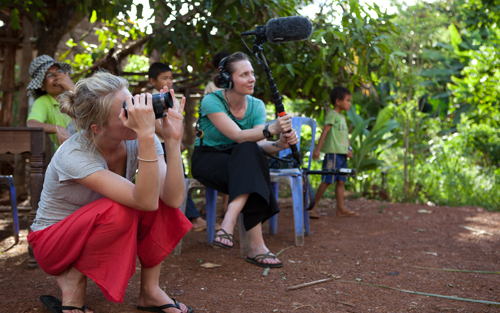
The plight of the non-profit has never been easy – the majority have always been faced with unstable funding sources which dictate how many services they can offer and to whom. As social media evolves and becomes more accessible to the masses, the competition between NGO’s also increases as they struggle to keep up with the fast-paced, ever-changing media landscape in order to gain and maintain secure funding.
The problem is that so many innovative programs are being run by NGO’s that don’t have the resources to tell their story effectively or reach the audiences they need to in order to receive recognition, support and funding.
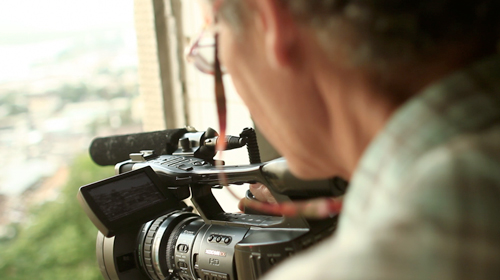
I’ve spent the last eight years creating media for organizations that work to advance women and girls. I’ve worked for larger organizations like UN Women and CARE and some smaller like OneHeart, and for the most part they all needed help defining their story; from refining their message to finding the most effective avenues to distribute their media. For these reasons I am leading Social Documentary Workshops as part of a current project of mine, Stirring the Fire. These workshops are intended to help advance gender equality by enabling women’s organizations to tell their story effectively and give them online strategies to get that story in front of their target audiences.
Our upcoming workshop in San Diego is sold out, but if you are a journalist, photographer, filmmaker, graphic designer, social media/communications student or professional, you can fill our this application to apply and be added to our mailing list for upcoming workshops (hint: the next destination might be near or around Nepal).
Our vision is to see this model not only scale but evolve, giving media students and professionals who would like to do social documentary work real world experience, and at the same time providing selected NGO’s with an affordable solution to effectively tell and get their story heard.
I have a 30 day documentary film project in Dolpa, a remote part of Nepal, which I’m going to be away from power for almost 30 days. This is the first time since I converted to digital capture that I’ll be off the grid for so long. I emailed some colleagues who shoot for NorthFace and had been given some pre-packaged products (by Goal Zero and Brunton) that they claimed did not work for their needs.
In researching the subject here is what I’ve learned:
1. To power my 15” Macbook pro, camera batteries (Canon Mark II & III 5D’s] and various AA’s I need a 60 watt solar panel. The lightest and most compact I have found is the P3-62 Foldable Sunling panel. It weighs 3 lbs and folds up to 15”x 8” x 1.5”
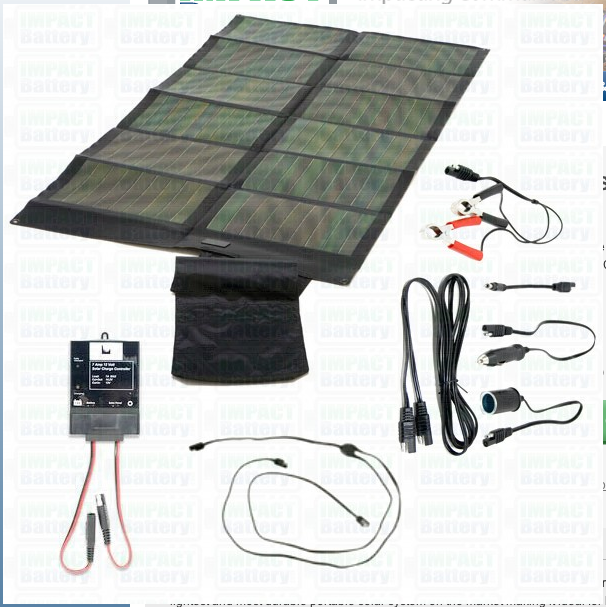
62 W Sunling panel kit $849 http://www.impactbattery.com/p3-62w-black-solar-panel-kit.html
2. From the panel I will be charging a 12 VOLT 10 Amp Hour LITHIUM IRON PHOSPHATE BATTERY (LFP). LFP batteries are half the weight of lead acid batteries and are cheaper and more environmentally friendly than Lithium cobalt batteries. This one weighs 2.5 lbs. and is 6” x 2.5” x 3.8”.
10 Amp Hour LFP battery $150 http://www.wholesalebatteriesdirect.com/66438-12-volt-10-ah-lifepo4-lfp12v10-lithium-iron-phosphate-battery.html
*note–It is necessary to have a controller between the solar panel and the LFP battery to avoid over-charging. The Sunling Panel kit listed above comes with a controller.
3. I plan to have the solar panel charging the battery outside my tent during the day then charging my various devices off the LFP battery at night. Here are some adaptors needed to charge my various devices from the LFP battery:

Battery to cigarette socket connector $5
3 way Cigarette Socket splitter and USB port $3
http://www.amazon.com/Three-Way-Cigarette-Lighter-Socket-Splitter/dp/B0018NB3OK/ref=pd_cp_e_1
Canon 5D adaptor $20 http://www.bhphotovideo.com/c/search?Ntt=peadccnlpe6&N=0&InitialSearch=yes
Macbook adaptor $28
Total cost–$1055
Canon 5D adaptor $20