
Because most of my work is now done in very remote areas without the help of a trained assistant, I have learned how to simplify my on-location lighting substantially. Now I choose lighting equipment based on its reliability, simplicity and weight.
When I first started making portraits of indigenous and tribal people in the field, I wanted to re-create the same lighting I was accustomed to using in the studio. So it was natural for me to think of a softbox as the best solution to get nice soft directional light. But instead of a light stand, I started using a tripod to accommodate the uneven terrain in the field. I would hang my Lumedyne power pack on the tripod to stabilize it in the wind. Then, it usually took me five to ten minutes just to set up the tripod and softbox. Once I started shooting, I found it very awkward to change the direction of the light while I was working with my subject.
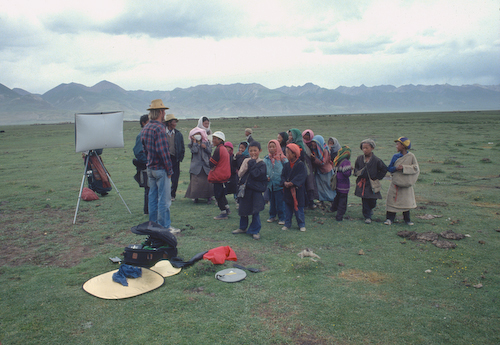
On one trip it finally dawned on me that I didn’t need to use a softbox since I didn’t have the problem of extraneous light bouncing back at me off studio walls. I could use an umbrella which was much easier to assemble. I also realized that I could almost always ask one of the many eager kids that would gather around to hold my light stand when the wind was blowing. So why did I need a stand at all?
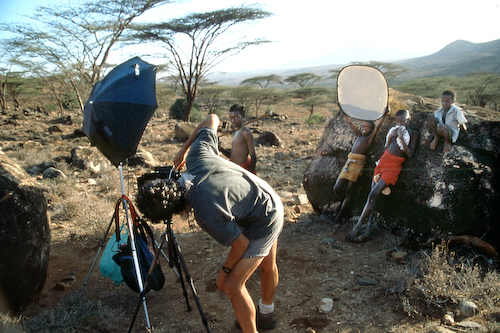
One of the wonderful things about photographing in the developing world is that the kids love to be around new technology and hence serve as wonderful assistants.
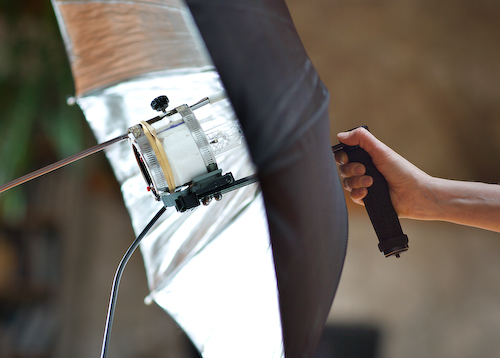
After I returned home, I modified a strobe bracket with some quick-release brackets and came up with a portable system that could be assembled in the field in less than a minute. This also allowed me to check my Polaroids and then change the direction and distance of the light in seconds.
Since then, I have simplified the whole process even further. For one thing, shooting digitally with my Canon 1ds Mark III allows me to check my strobe-to-ambient-light ratio on the LED of the camera. I no longer need Polaroids.
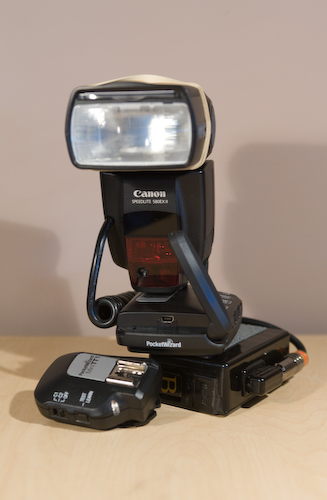
I used to use the ST-E2 Speedlight infrared sender, but it was unreliable in bright light. Now, to simplify matters even more, I use Pocket Wizard’s Flex TT5 and MiniTT1 to wirelessly fire my off camera flash (Canon 580EZ). I power the strobe with Underdog rechargeable batteries instead of AA’s (Underdog has unfortunately gone out of business). The battery pack is about the size of a pack of cigarettes and the universal charger is even smaller.
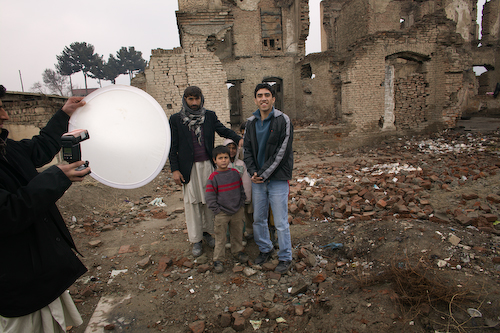
I now soften the light by having my assistant hold a twenty inch translucent disc about one foot in front of the strobe. I shoot one frame then check the LED. If the strobe light looks too bright or too dark I can quickly make adjustments with the flash exposure compensation dial on my camera body. It is so easy!
Tom Meyer
Is that a Quantum Quick Release Bracket punched through that umbrella? An amusing modification. And what kind of casing is that on the Lumedyne head? I think I can see their red test button and ready light sticking out the back. So have you completely moved away from Lumedyne? I am also moving toward shoe mounts (currently an SB800 and 900) with PW’s (but a piece of IR filter over the built in flash provides a viable and slightly more spontaneous setup, under compatible conditions). Currently looking for an alternative to the Underdog. Maybe a Lumedyne Cycler. Has the rather exposed connection via the AA compartment caused any issues for you, as in damp conditions? Thanks for this post, it all sounds familiar in a future leaning kinda way. Love what you do, and have for years… t
Phil Borges
Yes, Tom it is a Quantum Quick Release Bracket. I used PCV piping as casing on the Lumedyne head. I am finding that I don’t need as much light with digital, so I am moving away from Lumedyne and using the 580EZ the majority of the time. I am currently considering going to a Hasselblad digital back and portable Elinchrom strobes. I found that there were times I couldn’t power the Lumedynes down enough and I hear this isn’t an issue with Elinchrom. Please let me know if you find an alternative to the Underdog. I have not had any issues with the exposed connection. Thank you for your comment!
Tom Meyer
This site is an interesting way to waste an hour… but the technology seems well thought out. The “Black Box” may be your power supply solution. Let me know what you think:
http://www.aljacobs.com/my_products/the_black_box_story.html
Tom
Phil Borges
Hi Tom,
This is interesting using old, er “classic” battery technology for the pack. It looks like it is a bit larger than the Lumedyne pack I used to lug around, however as I said in the blog I’m mostly using my 580 EZ’s with an Underdog battery for my portraitlighting now days. My back thanks me!!
Whyteria Bullock
The “Canon EOS 1D Mark IV 16.1 MP” has HD video. Do you think it is possible to make a documentary using an EOS SLR camera that is the same quality as the short films for Women Empowered. You were talking about simplifying production. It just seems like it would be easier and less costly to use the Cannon EOS for photos and video instead of also purchasing a camcorder.
Also do you have experience using Gitzo tripods? I would like to limit the amount of weight I carry around by attaching a Mark IV camera to a Gitzo ocean tripod for video. At first I was hesitant because that was not the original intention of both technologies but you seem to be pretty creative when it comes to using photo technologies in a way that suits you best.
Phil Borges
It’s funny you should ask me this question at this time. I just purchased a Mark II 5d to use on my next project in the Copper Canyon of Mexico. I shot all the video in the Women Empowered series with a Sony EX1 which I highly recommend. The downside of the EX1 is it’s size. Since I shoot a lot of stills to augment my multimedia pieces it means carrying both my Canon Mark III 1ds and lenses as well as the EX1. I’m looking forward to the depth of field control and lens choices the 5d will offer, however, as I understand it, the ergonomics of using the camera as it is leaves a lot to be desired. First of all I recommend that you get a Z-Finder from Zacuto http://store.zacuto.com/Z-Finder.html or you will have problems with focus. Also, don’t rely on the camera for sound. I like the Marantz 661 field recorder, however, the smaller and less expensive Zoom H4N seems to be the most popular choice.
I’ll be able to tell you much more about using the 5d after this next trip.
I have used Gitzo tripods but I’m now using a Manfrotto 055mf3 with a 701HDV head. Both are lighter than recommended but it’s all the weight I want to carry and they seem to work fine.
Whyteria Bullock
You’re going to take photos of the Tarahumara? That’s really cool. Good luck!
Ellie Graham
Hi Phil
Glad to have found your blog. Very helpful! What is the handle in the 3rd photo?
Thanks!
Ellie
Phil Borges
My apologies for the delay in responding. That handle is actually a bracket assembly that wedding photographers use . . . I created this so long ago I don’t remember the brand.