
I’m often asked how I gain access and go about photographing people in the developing world. First of all your mental attitude as you approach someone to take their photo is critical to your success no matter if the person you approach is from a remote tribe in Irian Jaya or someone on the streets of New York. If you are approaching someone with the intent of taking something (i.e. a photo) you are immediately at a disadvantage. You are now up against the problem of having to convince them to give you something.
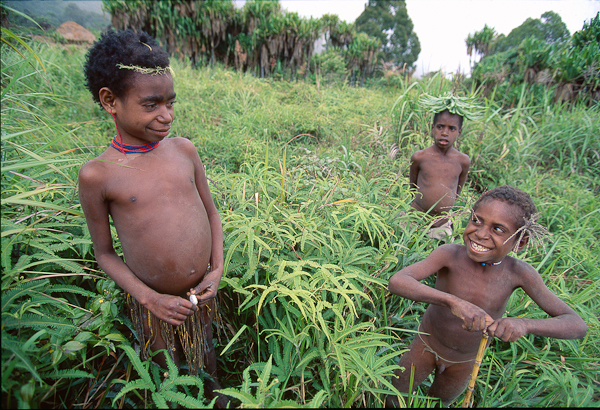
When I approach someone I am thinking and believe that I am about to give them something. For one I’m going to complement them by letting them know that I believe they are unique and interesting to me. I also know that I am going to give them a unique experience. It isn’t every day that someone comes up to you and asks if they can photograph you. You don’t even have to be able to speak to the person. If you are thinking it they will be able to read it in your body language. They can read if you hope to make their day or if you are just trying to get something out of them.
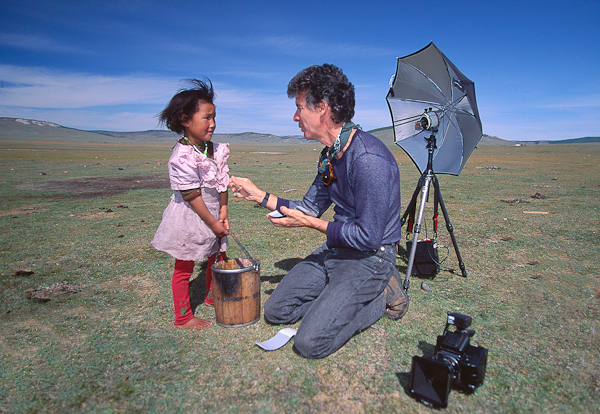
When I enter a tribe or village for the first time I almost always start by interacting with the kids. Kids are the most open and curious about new experiences. I take out my photographic equipment and begin taking photos of them and then giving them photos of themselves. It is my little magic show. Many times these kids ask to become my production crew. Before digital cameras I shot Polaroids, today I show them the LCD on the back of my camera and also carry a small battery operated HP digital printer so I can hand out prints. During my stay in the village these prints and Polaroid’s make it to their parent’s huts and soon I’m being invited into their homes and being asked to take photos of everyone. At this point the problem becomes how to take photos of everyone. I only carry a finite amount of Polaroids and ink cartridges! I find myself doing many group photos.
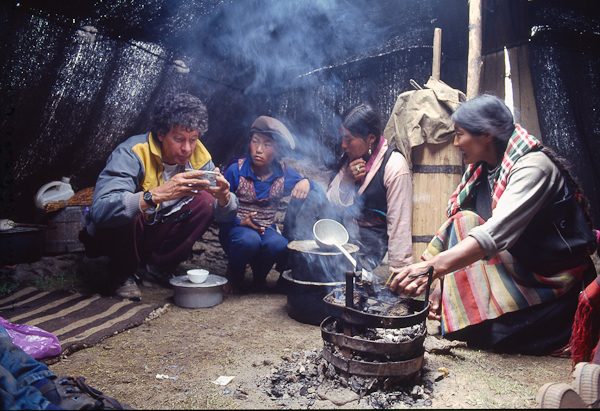
Even though I first approach people without an interpreter so they can get a sense of me through my body language, I always have someone available that can serve as a translator. I want to be able to tell them what I intend to do with the photos. In my case for exhibitions and books relating to an issue that their group is dealing with (human rights violations, poverty or environmental degradation).
I see many tourists taking photos of people in markets and villages without any meaningful interaction with the people they are photographing and many times getting a negative reaction. Just think how you would like it if someone came into your backyard and started taking pictures of you and your family without making a connection with you.
Photography can be a great ice breaker that will allow you to have a wonderful cross cultural experience.
Andy Schmitt
Hey Phil,
Great piece. I just wanted to mention Fuji’s version of the Polaroid films are pretty good, better on occasion. The “instant” film is an interesting semi-panoramic format & it shoots out of the top of the camera. The peel apart ones are great as well.
No, I don’t work for Fuji but I do use their films….a lot…
(& yes, the web site is a mess…sorry)
Thanks again for the piece, I’m sending the URL to some of my students.
admin
Thanks Andy! I really appreciate that you are sharing this information with your students. I will be posting more informational material soon. What camera are you shooting the Fuji Polaroid film with?
Phil
Beverly
Excellent advice! In my travels I’ve found the same thing–give of yourself first…then the people will be far more likely to allow photos. Moreover, the photos will be of happy smiling faces…not grimaces.
I truly admire all of your work and would love to participate in your endeavors if you need assistance from someone who supports the causes about which you feel so strongly.
I worked as an executive for Microsoft (in Seattle) for nine years… and then found my true passion…photographing and chronicling the lives of indigenous people around the world.
Keep up the great work. You are truly making a difference in the lives of these beautiful and loving people.
admin
Many thanks for the comment Beverly! I thoroughly enjoyed looking at your website. Great work!!
Phil
Gillian
Wonderful piece and great, practical advice to anyone who wishes to document their travels — you are visiting someone’s ‘home’ and it should be treated as such. I think we, tourists, forget all about the human touch and that although we may be from different regions, we all share so much in common; especially the need to connect.
I’m working to offer cultural experiences to teens in NYC (www.OneMindOpens.org) with the intention of taking them on international trips to experience how different cultures live, and your work is a great inspiration to me!
Please keep doing the work you do. I love the personal stories you include with your pieces.
Phil Borges
Thank you Gillian, your thoughts are very much appreciated. And I wish you the best with your organization – it has similarities to Bridges to Understanding – http://www.bridgesweb.org/.
paul siemering
You are doing just amazing, wonderful work Phil. I have been cruising around for hours and it is really overwhelming. So much compassion, and more than that, understanding all these wonderful people and pictures and stories.
thank you very much, and carry on
Paul Siemering
Phil Borges
Thank you Paul, I feel very fortunate to be able to do the work that I do. Your support is very much appreciated.
Kitty Alice Snead
The meaningful exchange of energy of which you write is a sign of respect that cuts across all races and cultures. And I’m glad you posted you’re comments. It is a good reminder to take the time to know the person before the lense.
Early on during my ten year project photographing the Tarahumara, another photographer and friend, Richard Speedy taught me by example to travel with a small Polaroid camera. I could give an ‘instant’ gift back to people who had no images of themselves. (That was before digital photography and small printers.) I’ve spent a lot of time on my knees photographing people of all ages and it has always given me great joy to watch their wonder at the emergence of their likeness appearing in their hands! I never tire of that.
I had another mentor, Douglas Hall, who photographed rodeo cowboys. Douglas told me he always sent a little money to the cowboy when he sold a print. He said it was always appreciated. That’s not always possible. But with the help of my Sierras guide, Santiago, individuals and communities have received an unexpected donation. Life is hard in the Sierras as it is in the remaining indigenous areas of the world.
My life has been blessed, as I’m sure yours has, to be offered friendship and acceptance by members of a culture different from my own. A viewer at an exhibition recently said I had received a great gift! Yes I have –to be allowed to observe, learn and work outside my culture. The gift is large including adventure, learning, & mutual respect. I have learned by experience a deep appreciation of the Tarahumara people, their beliefs and way of life.
Thank you for your statements, as a reminder of the rules of polite behavior for all visitors. And your responses back to those who have written you is admirable. It’s making a rich salon gathering for photographers.
Kit, ‘Alicia’
Phil Borges
Kit. What a great comment! Thanks for sharing!! For my last trip I was actually able to find another “polaroid” camera made by Fiji. I do prefer the Fiji over the little printers. Kind regards – Phil
Eric Mohun
Hi Phil; it’s been a few years since we’ve communicated, though I’ve been keeping track of your work and Bridges to Understanding’s programs. I am spending much of my time in aboriginal communities in western Canada and documenting my visits and interactions as best I can. I also find it essential to first build a relationship or “understanding” before I go clicking away. I have been able to use the images I’ve captured for many slide shows and videos to share with my clients in oil and gas industry with the intention of increasing cultural awareness for the people within the communities and regions where development is proposed. I am hoping to create a piece on aboriginal trappers, who continue to live off the land (hunting, trapping, gathering) amongst ongoing industrial development. Keep up with great work Phil.
Phil Borges
Hey Eric. Nice to hear from you. It sounds like a very interesting project you are working on. I am so glad to see that you are raising cultural awareness within the oil and gas industry. I wish you great success!