
While documenting Adam’s story and interviewing experts in the field of mental health I have become alarmed to learn how severe the mental health crisis currently is in the U.S.
 According to the National Institute of Mental Health, if current trends continue, one in five U.S. citizens will suffer a severe psychological crisis in their lifetime and one in twenty will become disabled by it. The NIMH goes on to say that 75% of these crises will occur in young adults.
The Social Security Administration tells us that the number of individuals on mental disability (SSI and SSDI) has more than doubled in the last twenty years. Furthermore, most young adults that go on disability will stay on it for the rest of their lives at a cost of over $1,000,000 per person. It’s estimated that 60% of our jail population and 25% of the homeless are suffering a mental illness. What is causing this epidemic?
What’s more puzzling is that the spending on pharmaceuticals, which is our main treatment for severe mental disturbance, has increased 80 fold, from $500 million to over $40 billion in the same 20 year period! Shouldn’t this be driving the mental disability numbers downward!?!
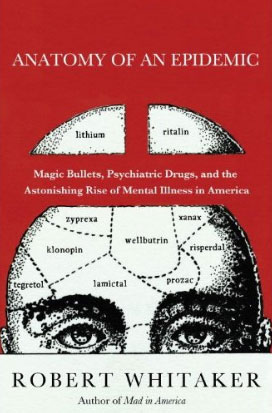
In a few days I will be going to Boston and Washington DC to seek out answers. One of the individuals I’ll be interviewing will be Robert Whitaker, whose book Anatomy of an Epidemic sheds light on this conundrum. In the weeks ahead we will continue to share the views of individuals who are offering solutions to the crisis we now find ourselves in.
Brent Williams
Thank you for seeking. Please don’t let the negative of what you find trouble you. We are evolving!
Bob Bennett
Among questions to ask: Why aren’t magnesium; iodine levels being checked more often? Magnesium deficiency causes serotonin-deficiency with possible resultant aberrant behaviors, including depression, suicide or irrational violence. (Transdermal Magnesium Therapy ©2007 by Mark Sircus, Ac., O.M.D pg. 172 ), and iodine deficiency also impairs fetal brain development. Salt used in processed foods is typically refined but not iodized. Oxygen deprivation can be mild, causing slow onset of symptoms, or severe, leading to rapid changes… Symptoms of mild cerebral hypoxia include inattentiveness, poor judgment, memory loss, and a decrease in motor coordination. / (What Are the Effects of Lack of Oxygen to the Brain? By Blake Biddulph http://www.ninds.nih.gov/disorders/anoxia/anoxia.htm) / More in my soon to be released book Liberty; Mental Health You Can’t Have One Without the Other.
Phil Borges
Thank you for the information Bob. I’ll check out the reference you shared.
Lynda
Thank you for an important talk, Mr. Borges.
I would like to share a few scholarly articles on the association between food intolerance and mental illness.
http://jnnp.bmj.com/content/72/2/259.full
http://www.ncbi.nlm.nih.gov/pubmed/16423158
http://www.ncbi.nlm.nih.gov/pmc/articles/PMC2856786/
http://www.researchgate.net/publication/261294813_Gluten_Sensitivity_Presenting_as_a_Neuropsychiatric_Disorder
Phil Borges
Thank you for sharing Lynda. I am glad to see the recognition of the how our food affects us in growing. I have a grandson with mild aspergers and a diet free of gluten has been very beneficial for him.
Thomas N. Carter, M.D.
Since the late 1980’s/early 1990’s the field of Psychiatry has seemed to have forgotten the importance of the need for early infant-maternal bonding, basic trust, building of healthy object relations progressively especially through the first 5-6 years of life and, thus, the need for knowledgeable reconstruction of the damaged process through long-term, gently persistent, individual psychotherapy, and supportive Family Systems Psychotherapy for the individual, where possible.