
Now that the web is nudging all of us photographers to create more than just stills to deliver our message we who work on location in remote areas are faced with the prospect of adding more equipment to the heavy packs we have been carrying for years!
Last year I traveled to Malawi, Zambia, Sri Lanka, Peru, India and Tibet to create short multimedia pieces for my ongoing project focusing on the empowerment of women and girls in the developing world.
In addition to my Canon 1Ds Mark III and various lenses (16-35mm f 2.8; 70-200mm f 2.8; 28-70mm f 2.8; 24mm f1.4) I was now carrying a Sony PMW-EX1 Camcorder; a Marantz 661 field DAT recorder; shotgun; omnidirectional; and wireless laviler microphones plus the tripod, lights, headphones, etc.
As you may have seen in a previous blog post, here is what it looked like on one of my trips to Tibet!!
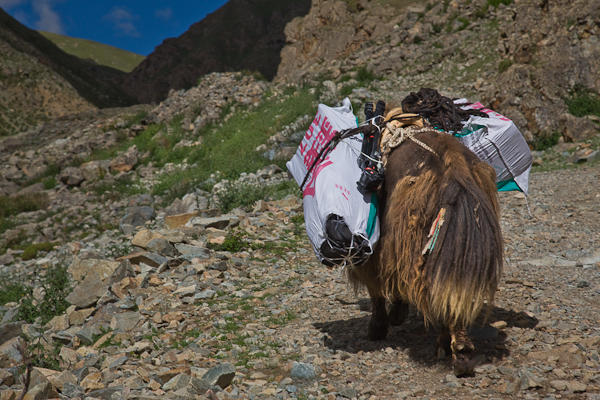
Not only is it a lot of weight that sometimes requires a Yak but in instances like this it makes getting to the equipment quickly a major problem—so much for spontaneity.
I’m on my way to Northern Mexico to do a story on maternal mortality among the Tarahamara Indians living in the Copper Canyon near Chihuahua. Here is what I’ve decided to do to lighten my load.
One of the great advantages of digital photography is the ability to shoot in low light. Instead of lugging around my heavy Lumedyne packs, batteries, and light heads I now just carry a Canon 580ez . In fact, I hardly light anymore and create my highlights in post production (shooting HDR and using the brush tool in Lightroom – see below) This has helped to lighten my load a lot.
My time in Mexico will determine whether I will replace my Canon Mark III 1Ds with a Mark II 5D to shoot both stills and video when needed. Though the 5D does needs a few add-ons to make it functional as a video camera. First, a Z-Finder from Zucuto is a must for getting accurate focus. Secondly, the Automatic Gain Control on the 5D makes it impossible to record a decent sound track. More on this in my next blog.
We are all waiting for the promised firmware upgrade for the 5D that will allow a 24 frame per second frame rate. Right now I’m not looking to use the 5D to completely replace my Sony EX1 but as I get used to shooting my interviews and B roll with it, I’m looking to the future and hoping I’ll be able to leave my EX1 at home. The new Canon Mark IV will make high ISO still and video shooting even more available and I assume it won’t be long before these new SLR cameras will be built more ergonomically to allow for easier video shooting.
Cheryl Hanna-Truscott
I hope you will write a blog upon return about how simplifying your equipment is working for you. Have a remarkable journey!
christine
Thanks for the tip Phil 🙂
Phil Borges
Thanks Cheryl and Christine – I’ll let you know how it worked.
joey b.
thanks phil hope you teach us how you do it!!!
MaryAnn Lynch
Thanks for all the useful information in this.
I’m wondering if you’ve also used the Canon Mark IV– my son is a sports photographer and he’s thinking of moving to the Mark III or Mark IV. He’d be grateful for any information from those who have used them both about whether it’s worth it to go the extra $$$ for the Mark III. He shoots primarily mixed martial arts and indoor sports right now. Perhaps you could help or point us in another direction. The specs of course are clear but there’s nothing like stories from the field.
Thank you Phil and best of luck on the Mexico trip. Such important work.
will you be at SPE National in
Phil Borges
If he is interested in shooting sports and especially martial arts which could be indoor, low light situations, he will most likely want to look at the new Cannon Mark IV 1ds which has an ISO range of 100 to 12,800 and a top ISO rating of 102,400. This will offer a combination of speed, accuracy and image quality.
Carole MacKay
…truly inspired and inspirational…
SHINE ON xx
Live Love
C x