
As many of you know the focus of my personal photographic work over the past 5 years has been around the empowerment of women and girls—especially in the developing world. This week there is a must read article in the NY Times Magazine by Nicholas Kristof and his wife Sheryl Wu Dunn for anyone interested in this subject.
The article states: “There’s a growing recognition among everyone from the World Bank to the U.S. military’s Joint Chiefs of Staff to aid organizations like CARE that focusing on women and girls is the most effective way to fight global poverty and extremism. That’s why foreign aid is increasingly directed to women. The world is awakening to a powerful truth: Women and girls aren’t the problem; they’re the solution.”
I just returned from a heartbreaking trip to Tibet where I planned to continue my work on women’s issues. I went to document the work of the NGO ‘One HEART’ which has been addressing the high rate maternal and infant mortality — especially among Tibet’s nomadic population.
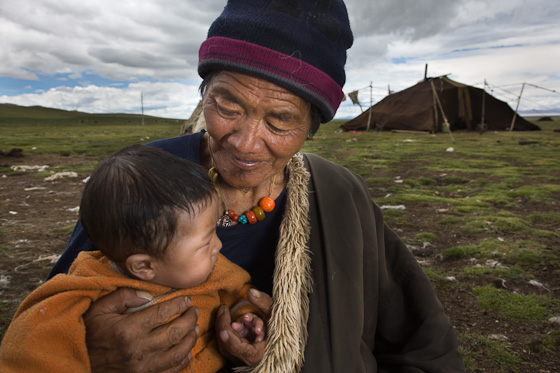
Tele who is 63 with his grandson Sonam Choedon. Sonam was born near Lake Namtso where One HEART hoped to start working this year. Like most Nomad children he was born only with the help of family members. Luckily the birth went without complications.
As in many parts of the world, indigenous people don’t get or seek medical help because of different cultural beliefs and misunderstandings. Many Tibetan Nomads believe that in the critical moments after birth the infant is very susceptible to a ‘Hungry Ghost’ that can jump onto and occupy the newborn. These ghosts that can be carried by any stranger are believed to make havoc in one’s life. Needless to say a Nomad doesn’t want a doctor or midwife that they barely know attending the birth of their child. They also believe that the blood of childbirth offends the spirits of the house. Therefore many births take place in a cold and dirty stable away from the warm fire in their yak-hair tents. It’s no wonder that an estimated three women died for every 100 births and one in ten infants did not survive their first year of life.

Adu, 26 and her husband Tadro, 31 live at 16,000 feet where they raise yaks and goats. Since the Tibetan’s have never had a midwife tradition, both of their children were born at home without any prenatal, birthing, or postnatal care.
To address these cultural beliefs One Heart’s Tibetan staff trained local nomadic women to be midwives and provided a plastic sheet to contain the ‘spiritual blood pollutants’ that could be taken out of the tent after the birth. The ten year old program has been extremely successful. Last year there were no maternal deaths in the two counties they worked in. Unfortunately, One HEART’s contract to continue their work was not renewed.
It is often said when a mother dies the family dies—students drop out of school to help take care of younger siblings, and fathers strain under the added workload. It is such a shame that a program that was so successful at saving families from the devastating effects of losing a mother had to end.
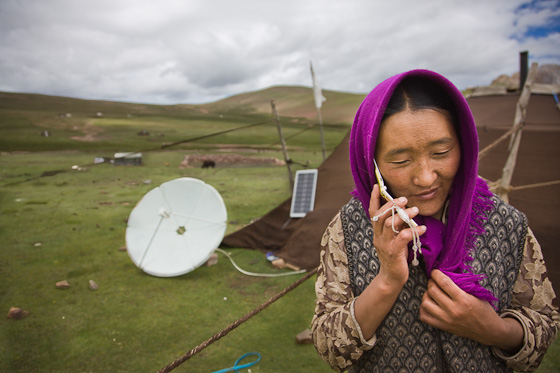
Nomadic life in Tibet is changing fast. Solar panels, cell phones and satellite radios are starting to appear. The cell phone is becoming an important tool in the campaign to reduce maternal mortality.
Thank you for visiting my blog! I welcome your comments and look forward to hearing what you have to say.
Phil Borges
PS: If you didn’t have a chance to read my previous blog postings from Tibet they can be found here:
Justin Hoch
Great post, Phil. Amazing photos and an intriguing situation, both hopeful and heartbreaking. Keep up the good work!
admin
Thanks for your kind words Justin!
Margaret
I recently came across your blog and have been reading along. I thought I would leave my first comment. I don’t know what to say except that I have enjoyed reading. Nice blog. I will keep visiting this blog very often.
Margaret
http://grantfoundation.net
admin
Great to hear Margaret – thank you!!
daniela
how wonderful to find your blog today. the photos are beautiful alone but your words are powerful too. you satisfy my cravings to see and learn about areas of the world i may never get the chance to visit. thank you.
Phil Borges
Daniela, I truly appreciate your comment. Hope you get to travel to your heart’s desire.
Cheryl Hanna-Truscott
I’m glad this issue is getting increasing attention. It’s nearly unbearable to imagine women going into labor alive and well, then losing their lives when some basically simple interventions could change it all around. I used to think that midwifery skills were always passed down from a skilled attendant to her mentees but have learned that’s not always the case. There is a lot of work to do to change this sometimes drastic situation. Thanks for taking note. Your work and that of Kristof & WuDunn will make a difference, along with midwives and other providers who recognize that something can be done.
Phil Borges
Cheryl I really appreciate your comment.
Gladys Falcon
Hi Phil, You are doing a very lovly and beautiful work, the photos mae me sad and happy. Keep up the good work,May God bless you and your cop-workers… A friend from Puerto Rico. 🙂
Janice Chung
Hi Phil, I have been following your website and now your blog since 2005. The day after your exhibit ended at the Bower’s Museum I found it on their website. I was so bummed but am grateful for internet, for I can continue learning and being inspired by your photos. When I first heard of the railroad establishment from Beijing to Lhasa I thought it would be a great trip to take but later learned how it’s a tool for the government to dilute the Tibetan culture as they take over their land. I suppose the declination of this permit is another step towards their goal, minimizing the Tibetan population. So my question is not “Why” but “How” do we stop this?… the answer came quickly, it’s the work like yours that brings awareness to the public and hopefully we, the human race, will preserve what is irreplaceable.
Through your photos and documentary, I find wisdom and love for life.
Thank you.
Phil Borges
Thank you for this Janice, on many levels.
HiseEpige
Lots of people write about this subject but you wrote down really true words.
joni
I’m doing a film and need to recreate the Tibetan nomad life.
In this scene they will have a television set. Do you have an idea of the brands and types of TVs they might have? Would they be Chinese? Would they be older style.Appreciate any help.
Joni
Phil Borges
Joni, I apologize for not responding sooner, though I would not have been much help as I did not notice the types of TV’s . . . . other than they were definitely not flat screens!
Thupten
I love the work that One HEART does. I’m studying public health in grad school and hope to help my family in Tibet someday. Thank you for sharing and posting beautiful photos.
Thupten
Also, I talked to the president of One HEART, and she said their Tibetan counterparts are still running operations in Tibet. I do not know how effective it has been though. I wish more information was available.